
I just spent a week in New Orleans watching the orthopedic industry try to figure out what it wants to be when it grows up.
AAOS 2026 packed the Morial Convention Center with hundreds of exhibitors and tens of thousands of attendees. The exhibit floor was exactly what you’d expect — massive booth builds, robotic arms doing demo cuts, and enough branded swag to fill a shipping container. But the real signal wasn’t in the booths. It was in the conversations happening around them.
Here’s what I took away — not as a surgeon, but as someone building the operational infrastructure that has to absorb whatever the clinical side invents next.
The Handheld Robot Land Grab
The robotics conversation has fundamentally shifted. Two years ago, the question was whether surgical robots justified their capital cost. That debate is over. The new question is whether you need a $1.5M robotic arm at all — or whether a handheld device that costs a fraction can deliver equivalent precision.
Three announcements at AAOS made this shift impossible to ignore.
Stryker launched the Mako RPS (Robotic Power System) in limited market release — a robotically-enabled saw that responds to a surgeon’s hand movements and guides the blade to stay aligned with the surgical plan. It’s designed for the surgeon who wants digital precision but isn’t willing to give up the tactile feel of a power tool. This isn’t Stryker hedging their bet on Mako. It’s Stryker recognizing that the addressable market for handheld is dramatically larger than the market for robotic arms.
THINK Surgical announced the first clinical cases using their TMINI miniature robotic system with Stryker’s Triathlon knee. That’s a competitor’s robot cutting a Stryker implant — and doing it well. THINK now supports nine compatible implant systems, positioning themselves as the implant-agnostic alternative to the closed ecosystems everyone else is building.
This is a bigger deal than the trade press coverage suggests. For years, robotic platforms have been a lock-in mechanism — buy the robot, buy the implants. TMINI unbundles the implant from the robot. That means facilities are no longer locked into a single vendor’s ecosystem, which cracks open the door for smaller manufacturers who could never justify building their own robotic platform. If you make a great implant but don’t have a $1.5M robot to pair it with, the open-platform model suddenly makes you competitive in facilities that were previously off-limits.
Smith+Nephew debuted the CORI Shoulder robotic shoulder arthroplasty system, with first cases completed at Duke Health. The design is explicitly optimized for ambulatory surgery center footprints — smaller, portable, faster setup. That’s not a coincidence. CMS added over 500 procedures to the ASC Covered Procedures List for 2026. The math on outpatient joint replacement is changing fast, and Smith+Nephew is betting that the robot needs to fit the room, not the other way around.
What this means for commercial ops: Every one of these platforms creates new SKUs, new instrument trays, new training requirements, and new field inventory to track. A distributor that was already drowning in charge sheets from conventional procedures is about to get hit with a wave of robotic-assisted cases that require more precise product tracking, more complex PO matching, and more coordination between the rep, the hospital, and the home office. The clinical innovation is real. The operational infrastructure to support it hasn’t caught up.
The GLP-1 Bone Bill Is Coming Due
The most clinically significant research at AAOS wasn’t about implants or robots. It was about the millions of Americans now on semaglutide and what that’s doing to their skeletons.
The AAOS-presented data showed a mixed picture. On the positive side, GLP-1 users showed significantly lower post-operative emergency department visits after total knee and hip replacement, and lower surgical site infection rates. Lighter patients, better outcomes short-term — that makes intuitive sense.
But the long-term data is concerning. GLP-1 users showed roughly 30% higher incidence of osteoporosis and nearly double the rate of osteomalacia (bone softening) compared to non-users. Gout incidence was also elevated. The hypothesis is straightforward: rapid weight loss creates nutritional gaps, and bones pay the price.
The practical implication is that bone health optimization is likely becoming a standard pre-operative step for any patient on GLP-1 agonists. That means longer pre-surgical timelines, additional labs, and potentially new product categories entering the orthopedic workflow.
This was visible on the expo floor itself. The number of nutrition solution providers exhibiting at AAOS was noticeably higher this year — companies selling bone density supplements, metabolic monitoring, and pre-surgical optimization programs. Orthopedics is continuing to move beyond the surgery and toward total-health management. For smaller manufacturers, this opens a partnership play that didn’t exist two years ago: pair your implant with a bone health optimization protocol, and you have a differentiated story to tell surgeons that has nothing to do with the size of your robotics budget.
The $20 Billion Question: DePuy’s Independence
J&J’s plan to separate its orthopedics business into a standalone DePuy Synthes was the dominant hallway conversation at AAOS. Bloomberg reported in February that J&J is exploring a $20B+ sale, with multiple PE firms circling the asset.
DePuy Synthes generated $9.3B in revenue in 2025. An independent DePuy would be the largest pure-play orthopedics company in the world. That’s not just an M&A story — it’s an operational earthquake for every distributor in the ecosystem.
Here’s why this matters for commercial teams: an independent DePuy, especially under PE ownership, will be under intense pressure to optimize margins from day one. That means scrutinizing every line item in the commercial operation — distributor economics, field inventory carrying costs, billing cycle times, processing labor. The companies that are still running their DePuy business on spreadsheets and email will feel that pressure first. And if DePuy goes on an acquisition spree to fill gaps in their digital portfolio (which every analyst expects), the integration complexity for distributors will compound.
Meanwhile, Stryker and Zimmer Biomet aren’t standing still.
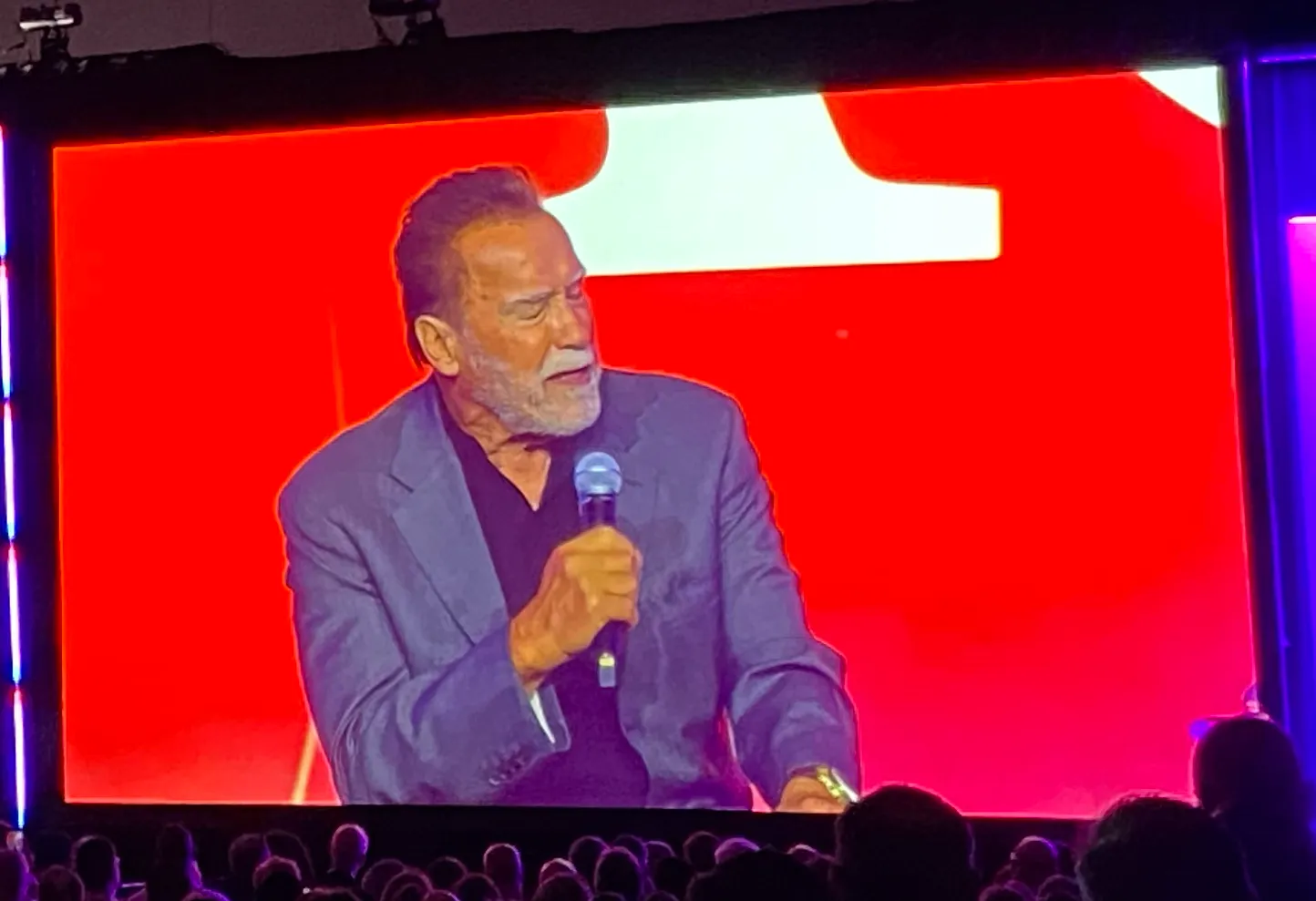
Zimmer Biomet brought Arnold Schwarzenegger to AAOS as their Chief Movement Officer — a branding play that signals ZB’s ambition to own the “movement company” identity beyond just implants. CEO Ivan Tornos joined Schwarzenegger for the Presidential Guest Speaker session, and the message was clear: ZB is positioning for a post-DePuy competitive landscape where brand and ecosystem matter as much as the metal in the ground.
Innovation Spotlight: MY01
One product stood out from the noise. MY01 took the 2026 OrthoPitch trophy for their Continuous Perfusion Sensing Technology — a real-time pressure monitor for diagnosing compartment syndrome. Today, compartment syndrome diagnosis is notoriously subjective (how much pain is the patient in? how tense does the compartment feel?). MY01 replaces that guesswork with continuous, Bluetooth-transmitted pressure data over 18 hours. If this scales, it changes the standard of care in trauma.
The Shift Nobody on Stage Named: From Transactions to Subscriptions
Every booth at AAOS was selling a version of the future — smarter implants, better robots, AI-assisted planning. But if you step back from the individual product announcements, a structural shift comes into focus that nobody explicitly named on stage.
The medical device business model is becoming a subscription.
Robots started this. Stryker doesn’t just sell a Mako — they sell a per-procedure fee, a service contract, ongoing software updates, and training programs that create a recurring revenue relationship with the facility. Now that model is spreading. Handheld robotics, digital planning software, remote monitoring platforms, bone health optimization protocols — more and more of what a manufacturer delivers isn’t a one-time capital purchase. It’s an ongoing service.
That fundamentally changes what it means to be a successful medical device company. The manufacturer’s success is no longer transactional — tied to the implant sale and nothing else. It’s increasingly relational, tied to the long-term success of a four-way partnership between the surgeon, the facility, the manufacturer, and the representative. Did the surgeon get trained properly? Is the instrument tray where it needs to be? Did the facility get billed correctly? Is the rep getting credit? Is the service contract being fulfilled?
All of that coordination takes a staggering amount of communication. And right now, most of it happens over group texts, email chains, and phone calls — the same infrastructure the industry used a decade ago.
A handheld robot system creates a new instrument tray that needs to be tracked across 40 field locations. An open-platform robot compatible with nine implant lines means nine different pricing contracts to validate on every PO. A subscription-model device means ongoing fulfillment, not just a one-time shipment. A new shoulder arthroplasty platform designed for ASCs means case data flowing from facilities with minimal administrative staff, where the rep’s charge sheet might be the only documentation that exists.
The clinical side of orthopedics is moving fast. The commercial model is shifting from transactional to relational. And the operational infrastructure to support either of those changes — let alone both — hasn’t caught up.
That gap is where we spend our days at Deviceflow. And based on what I saw at AAOS this week, the gap is about to get a lot wider before it gets narrower.
Anatoly Geyfman is the founder and CEO of Deviceflow, an operations automation platform for medical device commercial teams. He attended AAOS 2026 in New Orleans.