
AI agents are moving from read-only to read-write.
Until recently, AI could pull data from your business systems — look up an order, check inventory, run a report. Now it’s getting write access. Create records in your ERP. Generate purchase orders. Post invoices. Update inventory. Not just answering questions — taking action, no human touching a keyboard.
In software engineering, this shift already happened. Engineers describe what they want and AI agents write the code, run the tests, and ship it. In design, Figma just gave agents the ability to create directly inside design files. The tool that used to be the starting point for product development is becoming an execution layer.
For industries where data is already digital and structured, this works. For medical device operations, it doesn’t. Not yet.
The Data Problem Nobody’s Saying Out Loud
If you run commercial operations at a medical device company, you know what I’m about to describe.
More than 90% of purchase orders at our customers arrive by email, not EDI. Unstructured data isn’t the exception. It’s the default.
Your case data is a photo of a handwritten charge sheet, texted from a hospital parking lot. Shipping confirmations are PDF attachments buried in email threads. Contract pricing lives in a binder and also, partially, in the ERP — nobody’s sure which version is current. Customer service reps have critical context in their heads that has never been written down. Field reps have inventory in their trunks that your system thinks is somewhere else entirely.
None of this is structured. Almost none of it is connected.
Here’s the part that matters: your ERP, your CRM, your inventory system — they were all built to store structured data, not to create it. They assume someone already typed in the lot number, matched the price, verified the quantity. Every system in your stack makes that same assumption. The entire operation depends on a human translation layer — your ops team copying data from one place, reformatting it, pasting it into another, then chasing someone to confirm it’s right.
That’s not a workflow. That’s the bottleneck.
And it’s especially brutal in medical devices because the regulatory overlay — lot tracking, device tracking, expiry management — means you can’t afford to get it wrong. Meanwhile, the data originates in the least controlled environment possible: a rep’s phone, between cases, in a hospital parking lot.
The Wrong Response
The instinct when you hear “AI agents can write to your systems” is to go buy another system. Another dashboard. Another portal. Another tool that promises visibility, requires clean inputs, and creates one more screen for your team to toggle between.
We’ve watched this cycle for years. The new tool launches with a great demo. It works perfectly with clean, synthetic data. Then it meets reality — your reality — and it falls apart because it assumed structured inputs that don’t exist. Your team ends up doing the same manual work they were already doing, plus the overhead of maintaining the new tool.
If the data going into a system is garbage, the system doesn’t matter. You’re just moving the bottleneck to a different screen. Screen number seven.
The question to ask about any new tool — including ours — isn’t “what can it do?” It’s “where does it get its data?” If the answer is “from the same manual entry process you already have,” you haven’t solved anything. You’ve just added a step.
What Actually Works: Structure the Data at the Source
We spent the first year at Deviceflow learning this the hard way.
The temptation is to build on top of existing systems and try to make sense of the data after the fact. Reconcile after the case. Clean up after the entry. Catch errors after they’ve already delayed the invoice. That’s how most “automation” works — it automates the back half of a broken process.
What actually works is solving the data problem at the point of origin. Before anyone has to type anything. Before anyone has to re-key anything. Before the data enters any system of record.
Charge sheets get structured automatically the moment they’re sent. The rep emails or texts a photo — the same thing they were already doing. AI extracts the products, lot numbers, patient info, facility, and surgeon. It matches to contract pricing. It flags discrepancies. What used to take 15-20 minutes of manual entry happens in seconds, with higher accuracy.
ASNs flow straight into inventory without someone copy-pasting from an email. The 3PL sends the advance ship notice the way they always have. The system ingests it, matches it to the expected shipment, and updates inventory automatically.
Usage reports match to contract pricing before your CS team ever sees them. By the time a human looks at the transaction, it’s already structured, validated, and ready to invoice.
That data doesn’t just live in one place. It flows to every downstream system — your ERP, your billing system, your inventory platform — as clean, auditable data. Not replacing those systems. Feeding them properly for the first time.
Once that structuring layer exists, everything downstream changes.
What Becomes Possible
With structured data flowing automatically, AI agents can actually do what everyone’s been promising they can do.
Conversational access replaces tool navigation. Instead of logging into your ERP, finding the right screen, running a report, exporting to Excel, and building a pivot table — you ask a question in Microsoft Teams. “What shipped to Dr. Martinez’s cases last week?” “Which consignment locations are below par level?” “Show me every open PO over 30 days.” The system answers in seconds.
Today, the ability to answer operational questions is bottlenecked by the two or three people on your team who know how to navigate the system. Everyone else waits for them or builds their own workaround spreadsheet. Conversational access means every person on the team gets answers at the speed of asking.
Agents act proactively, not reactively. The system doesn’t wait for you to ask. It processes incoming charge sheets as they arrive and posts the invoice the same day. It monitors inventory levels and triggers replenishment when consignment stock drops below par. It flags expiring lot numbers 90 days out. It reconciles kit returns against expected contents and escalates discrepancies immediately.
Case-to-invoice goes from 10-14 days to same-day. Not because someone worked faster — because the manual steps between the case and the invoice don’t exist anymore.
Why Most Companies Won’t Go First
The honest answer is that changing processes that have worked (barely) for years is hard. Not technically hard — organizationally hard.
Your ops team has built muscle memory around existing workflows. They know the workarounds. They know which ERP screen to check when the report is wrong. They know to call Maria because she remembers the contract terms that aren’t in the system. Those informal knowledge networks are real, and they work — right up until they don’t scale, or Maria goes on vacation, or you acquire a company with a different ERP.
Nobody’s solving this for medtech because the people who could are too busy processing charge sheets by hand. It’s not their expertise, and they don’t have time to make it their problem. Most companies will wait, run a pilot, form a committee, and evaluate vendors for 18 months while their competitors are already operating differently.
The 10x Gap
But here’s what happens to the companies that go all-in.
A 10-person ops team that currently spends 70% of their time on data entry, reconciliation, and error correction suddenly has that time back. They don’t get smaller — they get dramatically more capable. The same team that was processing 200 cases a month and drowning is now processing 500 and asking what else they can take on. Proactive consignment management instead of reactive replenishment. Pricing optimization instead of chasing discrepancies. Building new customer relationships instead of firefighting existing ones.
Same headcount. Same office. Same payroll number. Completely different output. And it shows up directly on the P&L — faster cash cycles, lower error rates, fewer write-offs, better customer retention, and the ability to grow revenue without proportionally growing the team.
The Monday Morning Audit
You don’t need a consultant or a six-month evaluation to know where you stand. Track your incoming operations data for one week. Every charge sheet, every PO, every ASN, every usage report. For each one, answer two questions:
How did it arrive? Email, text, phone call, fax, paper? If it arrived as unstructured data — a photo, a PDF, a forwarded email — mark it.
How did it get into your system of record? If someone on your team manually typed it into the ERP, that’s your translation layer. That’s the bottleneck.
In our experience, the answer shocks people. More than 90% of purchase orders arrive by email. Charge sheets come in as photos. ASNs come in as PDF attachments. The vast majority of data entering your operations systems was manually re-keyed by a human — and every re-key is a chance for error, delay, and lost revenue.
Once you have that picture, the path forward is clear. Start with the highest-volume, highest-impact input — usually charge sheets. If you can structure that one data stream automatically, you fix the longest delay in your cash cycle and free up the most CS hours in a single move. Then work outward: ASNs, usage reports, inventory counts.
For a deeper look at how the full order-to-cash process breaks down and where automation fits, we put together a practical guide to order-to-cash automation that walks through the entire workflow.
Free Resource The Complete Guide to Order-to-Cash Automation for Medical Device Teams See where the bottlenecks are, what same-day invoicing looks like in practice, and how to calculate the revenue impact for your team. Read the guideThe Question That Matters
Operations leaders have earned their skepticism. They’ve been through ERP implementations that took two years and delivered 60% of what was promised. They’ve seen “automation” tools that just moved the manual work to a different screen.
The difference now isn’t smarter agents. It’s that the data problem is getting solved first. The AI isn’t sitting on top of your existing mess trying to make sense of it. It’s creating structured data at the point of origin — when the charge sheet is sent, when the ASN arrives, when the rep reports usage. By the time the data reaches your systems, it’s already clean, validated, and matched. The agent isn’t working harder. The data is better.
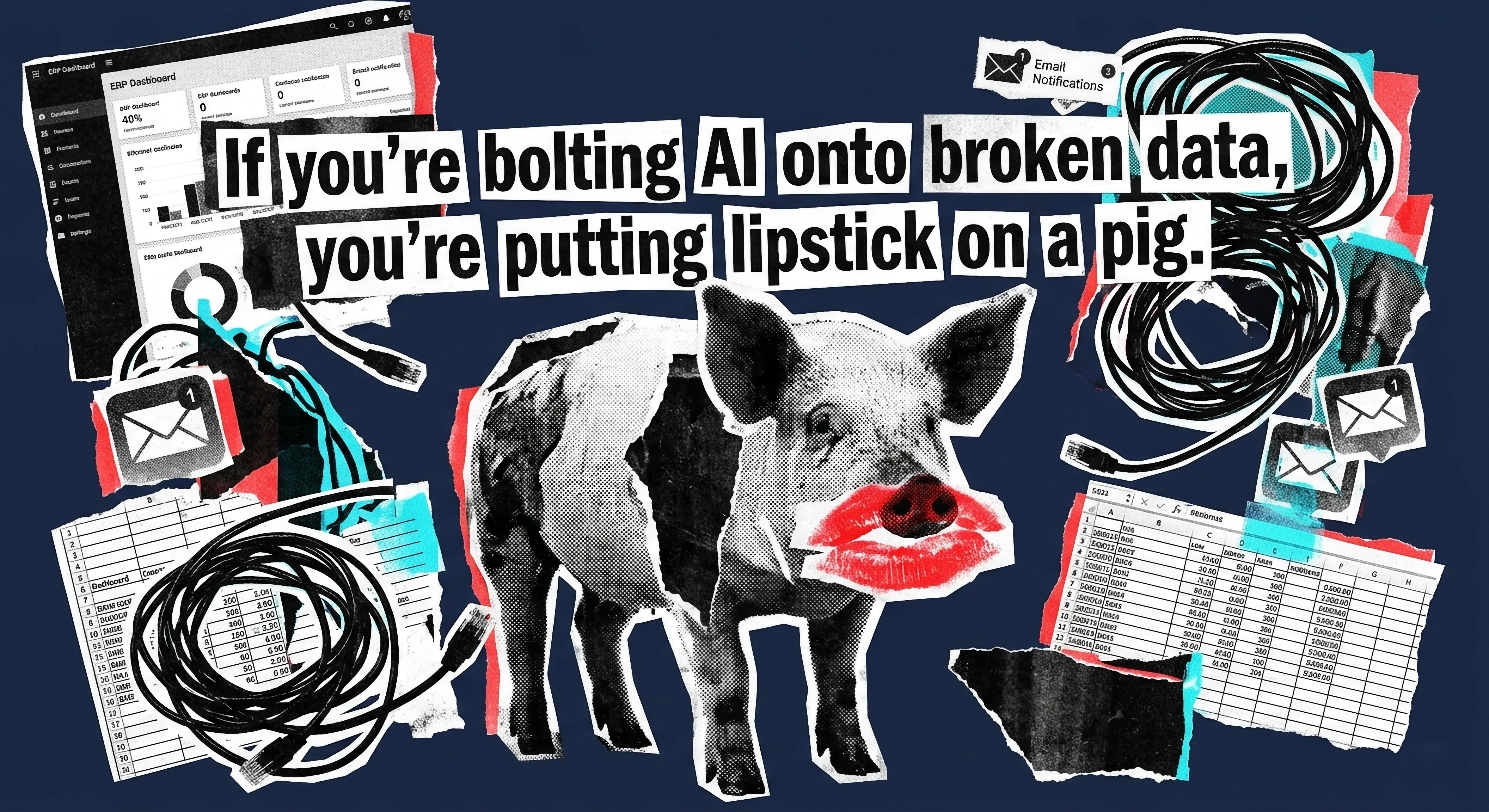
If you’re evaluating any new tool — AI-powered or otherwise — ask one question: where does it get its data? If the answer is the same manual process you already have, you’re putting lipstick on a pig.
Fix the data first. Everything else follows.