
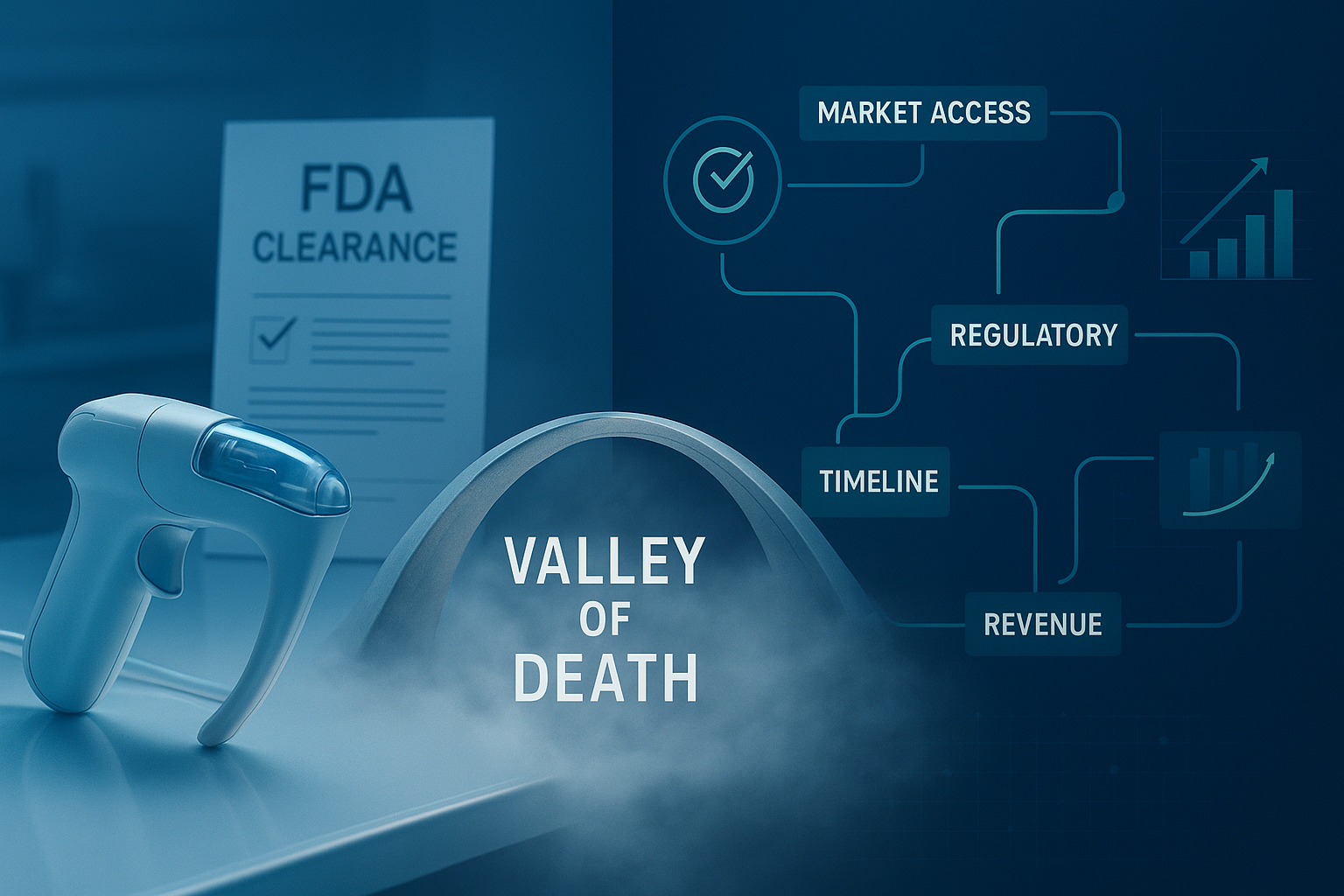
Your Device Works. Your Company May Still Fail.
The technology is brilliant. Your Class II device delivered clinical results that exceeded even your optimistic projections. The FDA clearance process, while grueling, confirmed what you already knew: this works. Your innovation solves a real clinical problem with measurable outcomes. By every technical measure, you’ve succeeded.
Here’s what the data won’t tell you during that victory celebration: three out of four companies with FDA-cleared medical devices never achieve commercial viability. Not because their devices don’t work—but because clinical validation and commercial success require entirely different playbooks. You just spent years and millions proving efficacy. Now you’re entering a phase that will cost $31 million more and take 3-4 times longer than your FDA clearance. In this phase, the rules change completely and technical excellence becomes necessary but not sufficient.
The “commercialization valley of death” earned its name honestly. It’s littered with devices that worked perfectly in clinical settings but never generated sustainable revenue. The difference between the 25% that survive and the 75% that don’t? It’s not better technology. It’s better strategy.
The companies that successfully navigate this journey don’t rely on luck. They follow proven frameworks that synchronize regulatory clearance, market access, reimbursement strategy, and commercial readiness into a cohesive commercialization architecture. This guide provides exactly that—a comprehensive roadmap based on current industry data, regulatory requirements, and real-world commercial launch experience.
Whether you’re a first-time medtech entrepreneur or an experienced executive launching your next innovation, this framework will help you transform clinical promise into sustainable market revenue.
Table of Contents
The 510(k) Pathway: Strategic Navigation Beyond Submission
The 510(k) pathway represents your regulatory gateway to market, but treating it as merely a compliance exercise is the first strategic mistake. FDA 510(k) review times have improved to approximately 169 days as of mid-2024, down from 179 days in 2023, as the agency works toward its MDUFA goal of 112 calendar days by FY 2025. However, this published timeline tells only part of the story.
Optimizing Your 510(k) Submission Strategy
Not all 510(k) pathways are created equal. The FDA offers three distinct submission routes, and choosing the right one can significantly impact both timeline and resource allocation:
Traditional 510(k): The standard pathway for demonstrating substantial equivalence to a predicate device. This route requires comprehensive performance data and is appropriate for devices with new intended uses or technological characteristics that raise different questions of safety and effectiveness.
Abbreviated 510(k): Allows manufacturers to declare conformity to recognized standards, special controls, or FDA guidance documents. This pathway can reduce review burden when applicable standards exist for your device type, potentially accelerating clearance by 20-30%.
Special 510(k): Reserved for modifications to your own legally marketed device when changes don’t affect intended use or fundamental scientific technology. This route leverages your existing design controls and quality system documentation, offering the fastest clearance timeline—often under 30 days.
Predicate Device Selection: The Foundation of Your Strategy
Your predicate device selection forms the cornerstone of your entire regulatory strategy. A weak predicate creates cascading problems throughout the submission process and beyond. Consider these strategic factors:
Clinical and technological similarity: Choose a predicate that minimizes the performance data gap. The closer your device’s technological characteristics and intended use align with your predicate, the less additional testing you’ll need to demonstrate substantial equivalence.
Market positioning implications: Your predicate choice signals your competitive positioning. Selecting a market-leading device as your predicate can enhance payer and physician perception, while choosing an older or less-recognized predicate may create downstream market access challenges.
Predicate stability: Ensure your chosen predicate device remains on the market and hasn’t been subject to recalls or safety concerns. The FDA tracks over 1.7 million injuries and nearly 83,000 deaths from medical devices over the past decade—association with a problematic predicate can derail your submission.
Q-Submission Timing: Reduce Risk Before Formal Submission
The FDA’s Q-Submission program represents one of the most underutilized tools for managing regulatory risk. By engaging FDA reviewers before your formal 510(k) submission, you can validate critical assumptions about predicate selection, testing protocols, and clinical data requirements.
Strategic Q-Submission topics include:
- Confirmation of predicate device suitability and substantial equivalence arguments
- Agreement on testing methodology for performance validation
- Clarification of biocompatibility or software validation requirements
- Discussion of clinical data needs and acceptable study designs
The investment in a Q-Submissiontypically 2-3 months of additional timeline and $20,000-$40,000 in consulting costspays dividends by reducing the risk of deficiency letters and additional information requests during formal review.
Managing Manufacturing Readiness in Parallel
One of the most common commercialization failures occurs when companies achieve 510(k) clearance but lack manufacturing capacity to fulfill initial demand. Your manufacturing readiness must develop in parallel with your regulatory submission, not after clearance.
Critical manufacturing milestones include:
Design transfer completion: Comprehensive documentation transferring design outputs to manufacturing specifications, with validation that production units meet design requirements.
Process validation: ISO 13485:2016 requires validation of processes where output cannot be fully verified by inspection and testing. For most Class II devices, this includes sterilization, welding, molding, and assembly processes.
Supplier qualification: Identify and qualify critical component suppliers early. The current global supply chain environment creates 6-12 month lead times for specialized medical-grade materials and components.
Unique Device Identification (UDI) implementation: FDA UDI requirements mandate that device labels include both human-readable and machine-readable device identifiers. Implementation requires coordination with an FDA-accredited issuing agency (GS1, HIBCC, or ICCBBA) and GUDID database submission.
Building Your Go-to-Market Architecture
With regulatory clearance and manufacturing readiness underway, your next critical pillar of commercialization is your go-to-market architecture. While 510(k) clearance grants you the right to market your device, it doesn’t guarantee anyone will buy it. Your go-to-market architecture must answer three fundamental questions: Why should customers choose your device? Which customers will drive initial adoption? How will you reach and serve them profitably?
Market Positioning and Value Proposition Development
Your device’s clinical performance data forms the foundation, but effective positioning requires translating that data into compelling business value for multiple stakeholders. In medical device purchasing, you’re rarely selling to a single decision-maker. B2B healthcare purchases in 2025 involve an average of 9 decision-makers and take 12 months to complete.
For clinicians: Frame your value proposition around clinical outcomes, procedural efficiency, and patient satisfaction. Surgeons and physicians care about complication rates, procedure time reduction, learning curve, and patient-reported outcomes. Translate your clinical data into these specific metrics.
For hospital administrators: Financial value dominates purchasing decisions. Calculate total cost of ownership including device cost, procedure time savings (operating room minutes cost $37-$63 per minute on average), complication reduction (average surgical complication costs $15,000-$30,000), and length-of-stay impact.
For purchasing departments: Demonstrate supply chain reliability, volume pricing flexibility, and compatibility with existing systems and workflows. Over 95% of US hospitals use GPOs to purchase devices, with the three largest GPOs—Vizient, HealthTrust, and Premier—representing over 75% of the market.
Competitive Differentiation Beyond Features
Feature-based differentiation alone rarely sustains competitive advantage in medical devices. Within 18-24 months of your launch, competitors will close technological gaps. Sustainable differentiation requires building advantages across multiple dimensions:
Clinical evidence depth: Invest in evidence generation that extends beyond FDA requirements. Peer-reviewed publications, registry data, and multi-center studies create credibility barriers that competitors cannot quickly replicate.
Economic outcomes data: Real-world economic studies demonstrating cost savings or revenue enhancement provide payer-relevant differentiation that clinical data alone cannot deliver. Budget impact models and cost-effectiveness analyses serve as powerful sales tools.
Procedural ecosystem: Consider how your device integrates into the broader procedural workflow. Training programs, procedural checklists, and patient education materials create switching costs that protect market share.
Target Customer Segmentation and Sequencing
Not all potential customers are equally valuable for initial launch. Strategic customer sequencing accelerates adoption by targeting early wins that create demonstration effects and reference selling opportunities.
Beta site selection criteria:
- High procedure volume (2-3x average) to generate rapid case experience
- Academic or teaching institutions with publication and presentation opportunities
- Clinical champions (physician advocates and key opinion leaders) with regional or national speaking platforms
- Facilities with established relationships to your clinical advisors or investors
Geographic concentration: Initial launch in 2-3 concentrated geographic markets allows your sales team to develop deep customer relationships, enables efficient training and technical support, and creates regional density that competitors must overcome.
Account tiering: Segment target accounts into tiers based on revenue potential, strategic value, and probability of conversion. Healthcare technology sales cycles average 12 months, making disciplined pipeline management essential.
Pricing Strategy: Balancing Value Capture and Market Access
Pricing decisions create irreversible market positioning. Price too high and you’ll face payer resistance and competitive vulnerability. Price too low and you’ll struggle to fund necessary evidence generation and commercial investments while signaling inferior quality.
Value-based pricing framework: Begin with the economic value your device creates. If your device reduces procedure time by 30 minutes at $50 per operating room minute, it generates $1,500 in time value. If it reduces complications by 5% and complications cost $20,000, it creates $1,000 in expected value per procedure. Your pricing should capture 25-40% of total value created.
Competitive positioning: Analyze predicate and competitive device pricing. For 510(k) devices, payers expect pricing within 10-15% of substantially equivalent predicate devices unless you can demonstrate superior clinical or economic outcomes.
Payer threshold analysis: Research payer coverage policies for similar technologies. Many payers use specific cost-effectiveness thresholds ($50,000-$150,000 per quality-adjusted life year) for coverage decisions. Price points exceeding these thresholds trigger additional scrutiny.
Reimbursement and Market Access Execution
Regulatory clearance and great clinical data mean nothing if physicians can’t get paid to use your device. Reimbursement strategy must begin during product developmentnot after 510(k) clearancebecause evidence requirements and timelines extend far beyond regulatory needs.
CPT Code Strategy and Application
Current Procedural Terminology (CPT) codes form the language of physician reimbursement. Without an appropriate CPT code, physicians cannot bill payers for procedures using your device, creating an insurmountable market access barrier.
Existing code utilization: Before pursuing a new CPT code, thoroughly analyze whether existing codes adequately describe procedures using your device. Existing code utilization offers immediate reimbursement, while new codes require 18-24 months for approval and an additional 12-18 months for payer adoption.
Category III pathway: When existing codes don’t apply and you lack sufficient clinical data for a Category I code, Category III codes provide a temporary tracking mechanism. These codes don’t guarantee payment but enable data collection to support future Category I application. Category III codes sunset after 5 years if not converted to Category I.
Category I application process: Category I CPT codes represent permanent additions to the coding nomenclature. The application process involves:
-
Application development (3-4 months): Comprehensive documentation including procedure description, clinical efficacy data, published literature, and current coding inadequacies.
-
CPT Editorial Panel review (6-12 months): The Panel meets three times yearly. Your application timing relative to meeting deadlines significantly impacts review timeline.
-
RVS Update Committee (RUC) process (6-12 months): If your CPT application succeeds, the RUC then reviews practice expense inputs and physician work values to recommend relative value units to CMS.
-
CMS final rule (12 months): CMS considers RUC recommendations and publishes final payment rates, typically effective the following January.
Total timeline from application to payment: 24-36 months minimum.
Payer Coverage Strategy: Sequencing and Engagement
Payer coverage doesn’t happen automatically upon 510(k) clearance. Each payerMedicare, Medicare Advantage, commercial insurers, and Medicaidmakes independent coverage determinations based on their own evidence standards and processes.
Medicare coverage pathway: Medicare coverage follows two potential routes:
-
Local Coverage Determinations (LCDs): Regional Medicare Administrative Contractors make coverage decisions for their jurisdictions. LCDs offer faster decisions (6-9 months) but require separate engagement with multiple contractors.
-
National Coverage Determinations (NCDs): CMS makes coverage decisions applicable nationwide. NCDs provide comprehensive coverage but involve rigorous evidence review and can take 12-24 months.
Commercial payer sequencing: Large national payers (UnitedHealth, Anthem, Cigna, Aetna, Humana) drive coverage cascades. Regional and smaller payers often follow national payer decisions, making early engagement with 2-3 national payers strategically critical.
Evidence requirements: Payer coverage decisions demand evidence beyond FDA requirements:
- Peer-reviewed published clinical data demonstrating safety and efficacy
- Comparative effectiveness data versus current standard of care
- Economic outcomes and budget impact analysis
- Clinical practice guideline inclusion or endorsement
- Real-world evidence from post-market use
The scope of clinical evidence required by payers often exceeds FDA requirements, creating a critical commercialization gap for companies that plan only for regulatory submission.
Coverage Negotiation Tactics and Medical Policy Development
Payer coverage negotiations require sophisticated understanding of health technology assessment and evidence standards. Successful medical policy development follows a structured approach:
Medical policy dossier development: Comprehensive evidence packages including systematic literature review, meta-analysis of clinical outcomes, budget impact modeling, and cost-effectiveness analysis provide the foundation for coverage discussions.
Key opinion leader engagement: Payers seek input from clinical experts during coverage reviews. Early engagement with recognized thought leaders who can speak to your device’s clinical utility and place in therapy significantly influences coverage decisions.
Pilot programs and outcomes-based agreements: When evidence gaps exist, outcomes-based contracts or coverage with evidence development arrangements allow conditional coverage while generating the real-world data payers require for permanent coverage decisions.
Operational Readiness and Supply Chain Optimization
Commercial success requires operational excellence that scales with demand while maintaining regulatory compliance and quality standards. Operational failuresstockouts, quality escapes, supply chain disruptionsdestroy commercial momentum that takes years to rebuild.
Manufacturing Scale-Up and Quality Systems
Transitioning from design verification quantities (typically 10-30 units) to commercial production (thousands or tens of thousands) reveals hidden process risks and capability gaps. ISO 13485:2016 quality management system requirements form the foundation of medical device manufacturing, but commercial readiness demands more.
Process validation completion: FDA and ISO 13485 require validation of manufacturing processes where results cannot be fully verified through inspection and testing. Process validation includes:
- Installation Qualification (IQ): Equipment and systems installed correctly
- Operational Qualification (OQ): Systems operate within specified parameters
- Performance Qualification (PQ): Processes consistently produce conforming product
Each validation typically requires 3 production runs with sample sizes determined by statistical process control principles. Total validation timeline: 3-6 months per process.
Design transfer documentation: Comprehensive specifications, manufacturing instructions, acceptance criteria, and quality control procedures enable consistent production. Incomplete design transfer creates the single largest source of post-launch quality issues.
Supplier quality management: Your quality system extends to your suppliers. Medical device companies face significant supply chain challenges, with critical component lead times stretching 6-12 months for specialized materials. Supplier qualification includes:
- Quality system assessment and audits
- Component specification and acceptance criteria
- Incoming inspection and testing protocols
- Supplier corrective action procedures
- Business continuity and risk mitigation planning
UDI Implementation and Regulatory Data Systems
FDA’s Unique Device Identification system requires device labelers to include UDI on device labels and packages and submit device information to the Global Unique Device Identification Database (GUDID). Class II devices must comply with all UDI requirements, including:
UDI label requirements: Both human-readable plain text and machine-readable AIDC (automatic identification and data capture) formats, typically using GS1 or HIBCC standards.
GUDID submission: Device identifiers and descriptive attributes must be submitted to GUDID before commercial distribution. Implementation requires coordination with labeling, packaging, and quality systems.
Inventory and Distribution Logistics
Medical device inventory management presents unique challenges that directly impact working capital and commercial readiness. Medical device manufacturers hold an average of 150 days of inventoryalmost half a year of inventory tying up precious working capital.
Demand forecasting: Early-stage demand forecasting faces enormous uncertainty. Conservative forecasting creates stockouts that damage customer relationships and enable competitive entry. Aggressive forecasting ties up capital and creates excess inventory risk. Use scenario-based forecasting (base case, conservative, aggressive) with flexible manufacturing agreements to manage uncertainty.
Distribution channel strategy: Device distribution follows several models:
- Direct sales and fulfillment: Highest margin but requires significant infrastructure investment in warehousing, logistics, and inventory management
- Distributor partnerships: Faster market access and reduced capital requirements but lower margins (typically 30-50% distributor margin)
- Hybrid model: Direct sales to large strategic accounts with distributor coverage for smaller accounts and geographies
Working capital requirements: Inventory, accounts receivable, and operational expenses create significant working capital demands during launch. Conservative planning assumes:
- 90-120 days inventory on hand
- 60-90 day accounts receivable cycles (hospitals pay slowly)
- 6-12 months operating expenses for sales, marketing, and support
For a Class II device with $500,000 monthly revenue target, working capital requirements reach $1.5-2.5M.
Sales Enablement and Commercial Launch
Even the best product fails without effective commercial execution. Sales enablement encompasses team building, training, tools, and launch strategy that converts market opportunity into revenue.
Building a High-Performance Medical Device Sales Team
Medical device sales requires a unique skill set combining clinical knowledge, consultative selling, and relationship building. Healthcare technology sales cycles average 12 months with multiple stakeholders, demanding persistence and strategic account management.
Sales model selection:
-
Direct sales force: Provides maximum control and customer intimacy but requires $200,000-300,000 per rep annually (salary, commission, expenses, benefits). Break-even typically requires $1.5-2M in annual revenue per territory.
-
Independent sales representatives: Lower fixed costs and established customer relationships enable faster market access. However, reps carry competing product lines and provide less control over messaging and customer experience. Commission rates: 8-15% of revenue.
-
Strategic distribution partnerships: Larger distributors offer national coverage and infrastructure but may bury your product within broad portfolios. Requires strong clinical differentiation and pull-through demand.
Compensation structure design: Align incentives with strategic priorities. During launch, weighted compensation favors new account acquisition over maintenance of existing business. Typical structure:
- 70% weight on new account revenue
- 20% weight on account penetration (revenue growth in existing accounts)
- 10% weight on strategic objectives (clinical champion development, peer-reviewed publications, speaker development)
Training Program Development
Medical device sales representatives must function as clinical educators and trusted advisors. Comprehensive training programs include:
Clinical and technical training (2-3 weeks): Deep understanding of clinical indication, procedure workflow, competitive products, clinical evidence, and hands-on device use.
Sales methodology training (1-2 weeks): Value-based selling techniques, account mapping, stakeholder analysis, and objection handling specific to your device.
Field coaching and certification (4-6 weeks): Supervised customer calls, procedural observation, and competency assessment before independent selling.
Total time to productivity: 3-4 months from hire to first sale.
Launch Execution Strategy
Commercial launches require methodical execution across multiple workstreams. Successful launches follow a phased approach:
Phase 1: Beta sites and clinical champion development (Months 1-3)
- 3-5 high-volume centers with clinical champions
- Intensive training and clinical support
- Case study and outcomes data collection
- Feedback integration and procedural refinement
Phase 2: Regional expansion (Months 4-9)
- Expansion to 10-15 target accounts in concentrated geographies
- Sales team hiring and training
- Marketing material development and refinement
- Early payer engagement and coverage discussions
Phase 3: National rollout (Months 10-18)
- Expansion to additional geographies and customer segments
- Sales team scaling to full coverage model
- Payer coverage achievement and promotion
- Publication of clinical outcomes and case studies
Clinical Champion Network Development
Medical Affairs and key opinion leader engagement play pivotal roles in successful device launches. Clinical champions serve multiple strategic functions:
- Early evidence generation: Procedural refinement, case series development, and outcomes data collection
- Peer education: Presentations at regional and national conferences, training programs for other physicians
- Payer credibility: Expert testimony and consultation during coverage reviews
- Reference selling: Peer-to-peer credibility with prospects evaluating your device
Effective clinical champion programs provide structured support including research grants, publication assistance, speaking honoraria, and advisory board participation—all within appropriate compliance guardrails.
Common Pitfalls and Success Factors
Now that we’ve covered the tactical elements of commercialization—from regulatory strategy through sales execution—let’s examine where others have failed and what separates the 25% that succeed from the 75% that don’t. Understanding these patterns provides the clearest roadmap for success. The 75% medical device company failure rate stems from predictable mistakes that disciplined execution can avoid.
Critical Mistakes to Avoid
Premature scaling: Hiring large sales teams, building inventory, and expanding geographies before validating product-market fit and sales process efficiency burns capital and creates organizational chaos. Scale only after demonstrating repeatable sales success at 3-5x target per-rep productivity.
Underestimating market access timelines: Reimbursement can take 3-4 times longer than 510(k) clearance. Companies that plan only for regulatory timeline face cash flow crises when commercial traction lags expectations. Build market access strategy and evidence generation into your product development timeline.
Weak economic messaging: Clinical differentiation alone rarely drives purchasing decisions in cost-constrained healthcare systems. Without compelling economic value propositions demonstrating total cost of ownership benefits or revenue enhancement, your device becomes a “nice to have” rather than a “must have.”
Single-payer dependency: Companies that achieve early Medicare coverage or single large GPO contract success often face catastrophic risk when that coverage terminates or competitor entry occurs. Diversified payer and customer mix creates resilience.
Insufficient capital reserves: Underestimating commercialization capital requirements forces suboptimal decisionscutting sales support, delaying evidence generation, accepting unfavorable distributor terms. Conservative financial planning assumes 50% higher costs and 50% longer timelines than initial projections.
Success Factors from Market Leaders
Analysis of successful Class II device launches reveals consistent patterns:
Parallel pathway execution: Market leaders begin reimbursement strategy, clinical evidence generation, and commercial planning during product developmentnot after 510(k) clearance. This parallel execution compresses time-to-revenue by 12-18 months.
Evidence generation mindset: Successful companies view evidence generation as continuous strategic investment, not one-time regulatory requirement. Registry studies, health economics research, and peer-reviewed publications create sustainable competitive advantages and payer credibility.
Customer co-creation: Beta site programs and controlled launches enable iterative refinement with physician input before broad launch. This co-creation builds clinical champions, validates value propositions, and de-risks full commercial rollout.
Financial discipline: Successful companies maintain 18-24 months cash runway at all times, providing flexibility to adapt to market feedback and weather unexpected obstacles without distressed fundraising.
Strategic patience with tactical urgency: Market-leading companies demonstrate patience in building sustainable market access and clinical evidence while executing daily operations with urgency and discipline.
Your 18-24 Month Commercialization Roadmap
Transforming clinical innovation into commercial success requires orchestrating multiple parallel workstreams across an 18-24 month timeline. Here’s your quarter-by-quarter roadmap:
Months 1-6: Foundation Building
Regulatory clearance achievement:
- 510(k) submission and clearance (if not yet completed)
- Manufacturing validation completion
- UDI implementation and GUDID submission
- Quality system certification (ISO 13485)
Market access groundwork:
- CPT code analysis and application (if required)
- Payer landscape assessment and engagement prioritization
- Medical policy dossier development
- Health economics study design and initiation
Commercial preparation:
- Go-to-market strategy finalization
- Pricing and positioning validation
- Beta site selection and contracting
- Sales model selection and hiring initiation
Capital requirement: $800,000-1,200,000 (regulatory completion, early evidence generation, team building)
Months 7-12: Beta Launch and Validation
Beta site execution:
- 3-5 beta site installations and training
- Intensive clinical support and case observation
- Case study development and outcomes data collection
- Procedural refinement and feedback integration
Commercial infrastructure:
- Sales team hiring and training completion
- Marketing collateral and sales tools development
- Distribution infrastructure establishment
- CRM and sales operations setup
Market access progression:
- Early payer engagement and coverage discussions
- Clinical champion network development
- Conference presentations and publication submission
- Health economics study data collection
Capital requirement: $1,200,000-1,800,000 (beta site support, team scaling, initial marketing)
Months 13-18: Regional Expansion
Revenue acceleration:
- Expansion to 10-15 target accounts
- Sales team productivity optimization
- Account penetration and pull-through programs
- Customer success and support infrastructure
Evidence and access:
- Peer-reviewed publication of clinical outcomes
- Payer coverage achievement (Medicare LCD or commercial)
- GPO engagement and contracting initiation
- Real-world evidence registry enrollment
Operational scaling:
- Manufacturing capacity expansion
- Supply chain optimization
- Quality system maturation
- Inventory and demand forecasting refinement
Capital requirement: $1,500,000-2,500,000 (sales team scaling, marketing expansion, inventory investment)
Months 19-24: National Scaling
Market expansion:
- Geographic expansion to additional regions
- Sales team scaling to full coverage model
- Strategic distribution partnerships (if applicable)
- National marketing programs and thought leader engagement
Market access maturity:
- Additional payer coverage achievements
- GPO contract execution
- Medical society guideline inclusion efforts
- Health economics publication and promotion
Total 24-month capital requirement: $3,500,000-5,500,000 depending on sales model, device complexity, and market access challenges.
Success Metrics to Track
Regulatory and quality:
- 510(k) clearance achievement and timeline
- Zero significant quality events or customer complaints
- ISO 13485 certification maintenance
Market access:
- CPT code approval (if applicable)
- Number of payer lives with coverage: 50M+ (regional success), 150M+ (national success)
- Percentage of procedures with coverage: 70%+ target
Commercial traction:
- Beta site case volume: 50-100 procedures across sites
- Sales pipeline development: 3x revenue target in qualified pipeline
- Revenue per sales rep: $1.5M+ annually at maturity
- Customer retention: 85%+ accounts reordering
Clinical validation:
- Published case series or study: minimum 1 peer-reviewed publication
- Clinical champion network: 10-15 active champions
- Conference presentations: 3-5 major conferences
Turning Clinical Promise into Patient Impact
The journey from 510(k) clearance to sustainable market revenue represents one of the most challengingand most rewardingaspects of medical device innovation. The 75% failure rate isn’t destiny; it’s the result of preventable strategic mistakes.
The companies that successfully navigate commercialization share common characteristics: they begin market access planning during product development, not after regulatory clearance. They build evidence that serves both regulatory and reimbursement requirements. They validate commercial assumptions with beta customers before scaling. They maintain sufficient capital reserves to execute patiently and strategically.
Most importantly, they recognize that regulatory clearance represents the beginning of the commercialization journey, not the end.
Your clinical innovation has the potential to improve patient outcomes, enhance procedural efficiency, and advance the standard of care. But potential means nothing without execution. The frameworks, timelines, and strategies in this guide provide your roadmap.
The valley of death is real, but it’s not insurmountable. With rigorous planning, parallel execution, adequate capital, and strategic patience, your Class II medical device can achieve its ultimate purpose: improving patient lives at scale.
The clinical validation is complete. The regulatory pathway is clear. Now it’s time to build the commercial infrastructure that transforms innovation into impact.
Sources and References
- Boyd Biomedical: The Top Reasons Why Medical Devices Fail
- Focused Ultrasound Foundation: Medical Technology Development Ecosystem
- MedTech Dive: FDA 510(k) Approval Timeline Analysis
- FDA: MDUFA Performance Goals and Procedures FY 2023-2027
- American Medical Association: CPT Code Process and Approval
- Health Affairs Scholar: Role of GPOs in Hospital Product Choice
- FDA: Medical Device Coverage Initiatives
- MedDevice Online: From Approved to Covered
- ISO: ISO 13485:2016 Medical Device Quality Management
- FDA: Unique Device Identification System
- Martal Group: Healthcare Sales in 2025
- LeanDNA: Medical Device Inventory Management
- AMA: RVS Update Committee Overview
- Definitive Healthcare: Medical Device Launch Strategy Guide
- IQVIA: Medical Launch Readiness White Paper