
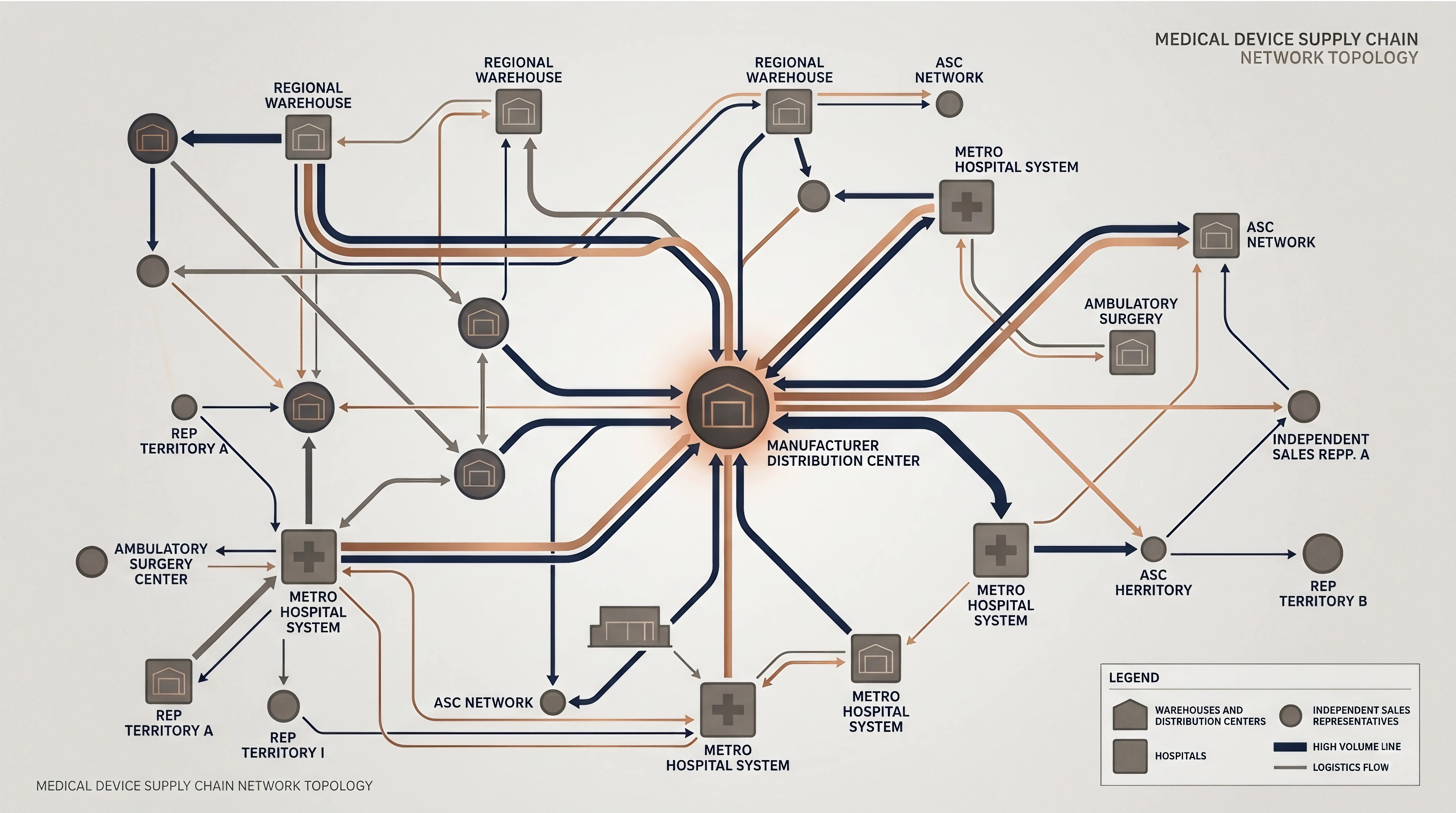
In most industries, the phrase “our sales team” describes people who work for the company. In medical device distribution, it describes independent contractors who work for themselves, carry five to ten competing product lines, and make daily decisions about which manufacturer deserves their attention. The distinction is not semantic. It is structural — and it changes every strategic calculation downstream.
The U.S. orthopedic device market hit $39.6 billion in 2023, representing 67% of the $59 billion global ortho market and growing at 6.3% annually (ORTHOWORLD 2024 Annual Report). This market runs primarily on a network of 1099 representatives. Commission structures range from 10–30% depending on product category and complexity, with medical disposables at the low end and capital equipment at the high end. Distributor-level arrangements can run 25–35% for recurring consumables. As one orthopedic company co-founder described the current landscape: “It’s a 50/50 split now where they have in-house reps that work direct… and then they’ll hire distributorships” (Tegus Interview — Orthopedic Company Executive).
These are not employees optimizing for the company’s goals. They are economic actors optimizing for their own throughput. And the market structure reinforces this — fewer than 50 companies exceed $100 million in revenue, roughly 50 companies account for about 85% of all sales, and 7 companies over $1 billion generate $39 billion of the total (ORTHOWORLD 2024). Everyone else is fighting for attention in the independent rep’s bag.
Understanding this distinction — truly understanding it, not just acknowledging it in a strategy deck — is the difference between manufacturers who grow and manufacturers who plateau.
The throughput calculus
Every morning, an independent surgical rep makes a set of decisions that determine which manufacturers earn revenue that day. The calculus is not primarily about product quality. As one executive at a major field operations platform put it: “The orthopedic space, in particular, is becoming slightly more commoditized. There’s not as much differentiation between the product… Once you get into the commoditization market, operations have historically become more important” (Tegus Interview — Field Operations Executive).
In a market where clinical outcomes between competing implants are converging, a $50,000 hip case generates roughly the same result and roughly the same commission regardless of manufacturer. So the tiebreaker is operational. Which manufacturer’s purchase order gets processed without requiring a follow-up phone call? Whose back office confirms cases within hours rather than days? Whose commission statements arrive accurately the first time?
This is not a theoretical concern. KPMG’s analysis of medtech commercial models found that “economic benefit value props are becoming almost as important as clinical efficacy” in device purchasing decisions (KPMG, 6 Key Challenges for Medtech Sales Growth, 2022). The same executive elaborated on the mechanism: “Pricing pressure has become more significant because expenses like excess and obsolescence are becoming more expensive. It’s forcing these organizations that have historically been primarily focused on sales to start focusing on operations for the first time” (Tegus Interview — Field Operations Executive).
The answers to these operational questions determine how $50,000 surgical cases get steered — not at surgeon dinners, not at sales kickoffs, but in the quiet friction of daily operations. Salesforce’s 2026 State of Sales report (cross-industry, not medtech-specific) put reps at 60% of their time on non-selling work, including 11% on manually entering data (Salesforce, 2026, p. 8). In a 1099 channel where the rep is choosing between four manufacturer lines, every hour of that work is a structural tax on throughput — and it falls disproportionately on manufacturers whose back-office operations create the most friction.
Most small and mid-market manufacturers misread this dynamic. They invest in training programs, quarterly business reviews, and relationship management as though these reps report to them. The logic is inherited from the direct salesforce playbook: invest in your people, align incentives, build loyalty. But you cannot build loyalty into a distribution network. You can only build preference — and preference in a network is a function of friction, speed, and transparency.
What to do about it
Start by auditing the actual rep experience end-to-end — not from the manufacturer’s perspective, but from the rep’s. Shadow three to five of your highest-volume independent reps for a week. Document every touchpoint where they interact with your back office: how they submit cases, how they confirm pricing, how they check commission status, how they resolve discrepancies. Count the emails, texts, and phone calls each case generates before it closes.
Then rank those touchpoints by friction. The ones generating the most back-and-forth are where you’re losing preference to competitors who’ve already solved the problem. The fix does not start with technology — it starts with mapping the workflow your reps actually use (which is almost certainly not the workflow your ops team thinks they use). Most manufacturers discover that 60–70% of the friction comes from two or three specific bottlenecks: PO confirmation delays, pricing mismatches, and commission statement disputes.
The Zimmer signal
Zimmer Biomet’s decision to transition all 2,500 of its U.S. representatives to a fully dedicated, specialized salesforce by the end of 2027 is the most significant structural shift in orthopedic distribution in a decade. The company’s CEO, Ivan Tornos, has been explicit about the rationale: competitors with dedicated, specialized salesforces are measurably more productive. Zimmer plans to increase its specialized rep count by 3.5 times between 2024 and 2027.
The broader industry context makes the timing intelligible. McKinsey’s 2025 analysis of 200+ medtech companies found that industry operating margins have dipped below 2019 levels. Only one in four medtech companies grew profitably above average, and fewer than 25% were expected to improve both growth and margin between 2024 and 2026 (McKinsey, The Transformation Imperative in Medtech, 2025). The margin squeeze is real and widespread.
Roland Berger’s data quantifies what separates winners from the rest: top-performing medtech companies run SG&A at 28.6% of revenue, while underperformers sit at 34.4% — a nearly 6-point gap that translates directly to competitive capacity (Roland Berger, Global MedTech, 2022). EY’s 2025 Pulse of the MedTech Industry report reinforces the divergence: the industry has split into a two-tier pattern where “commercial leaders” are growing at 8% while the rest are contracting. The number of companies in the underperforming tier has fallen 11%, while commercial leaders have risen 20% (EY, Pulse of the MedTech Industry, 2025). The gap between winners and losers is widening, not closing.
The implications for everyone else deserve careful attention.
For independent manufacturers — companies doing $5–50 million without a Zimmer-sized balance sheet — building a dedicated direct salesforce is not a viable response. Push SG&A to 45% of revenue and hope volume catches up is a strategy that has failed repeatedly at this scale. McKinsey identified six transformation levers for medtech companies under margin pressure, including “commercial excellence” and “cash optimization” — specifically to “streamline contracting and invoicing processes” (McKinsey, 2025). The message is clear: operational efficiency is the path, not headcount expansion.
The viable response is to become the most attractive option in the independent rep’s bag. Not through better dinners or bigger bonuses, but through operational infrastructure that makes the rep’s life measurably easier. Compress case-to-payment from 60–90 days to single digits. Process purchase orders without requiring the rep to send a confirmation email about something they already texted. Make commission statements accurate the first time so the rep never has to call your accounting department.
One orthopedic company leader described saving “eight to 10 hours a week minimum of coordination” after implementing scheduling technology — time that went straight back into selling (Tegus Interview — Orthopedic Company Executive). That same leader was blunt about the pressure driving the change: “We’re asked to do more with less all the time. Margins are going down, so we need to find different ways to cut inefficiencies” (Tegus Interview — Orthopedic Company Executive).
Distributors who have compressed payment cycles report that reps actively steer cases their direction — because in a world where the product is clinically equivalent, the fastest-paying, lowest-friction manufacturer wins the mention.
What to do about it
You cannot match Zimmer’s balance sheet, so don’t try to replicate their strategy. Instead, exploit the structural advantage you have that Zimmer is giving up: the independent rep network. Zimmer’s move to a dedicated salesforce means 2,500 reps who currently carry Zimmer alongside other lines will need to either go exclusive or drop Zimmer entirely. Some of those reps will be looking for a manufacturer to fill the gap in their bag. That’s a recruiting window — but only for manufacturers whose operational infrastructure makes it easy to onboard and support independent reps at scale.
The tactical play: benchmark your case-to-cash cycle against your top three competitors. If you’re paying commissions in 60+ days, compress it to under 14. If your reps are calling your accounting team to reconcile statements, build a self-service portal — even a simple shared dashboard that updates daily. These are not expensive investments ($5,000–$15,000 to implement), but they are the operational signals that determine whether a rep adds your line or drops it. Run a quarterly “rep friction survey” — five questions, anonymous, focused on where your operations slow them down. The answers will tell you exactly where to invest next.
The ASC migration changes the math
The structural shift toward ambulatory surgery centers is accelerating the importance of operational infrastructure. Industry projections now estimate that 50% to 60% of large joint procedures will be performed in ASCs within the next five to ten years, up from single digits a few years ago (Tegus Interview — Field Operations Executive). Another orthopedic company leader cited even more aggressive near-term numbers: “The numbers they’re projecting… 20%–40%+ in the surgery center setting in 2025” (Tegus Interview — Orthopedic Company Executive). IQVIA’s 2026 State of MedTech report confirmed the trajectory: “ASCs continue to gain share of the outpatient procedure market” (IQVIA, 2026).
Most manufacturer strategy teams frame this as a clinical trend. It is more accurately an operational one.
The economics explain why. An operations executive at a major ambulatory surgery alliance described the ASC advantage in concrete terms: surgery costs run roughly 50% less than hospital settings, with EBITDA margins of 35–40%. A single center can carry $1 million in device inventory per quarter. And critically, 10–15% of ASCs are still scheduling on paper (Tegus Interview — ASC Operations Executive).
ASCs buy differently than hospitals. Volumes per facility are smaller. Budgets are tighter. Administrative teams are lean — often three to five people managing the entire operation. Their tolerance for billing complexity approaches zero. They want the device, the documentation, and the invoice handled cleanly, handled fast, handled once.
The infrastructure gap is significant. One orthopedic company co-founder estimated that “80%–90% [of ASCs] are extremely under built when it comes to the processing of surgical equipment” (Tegus Interview — Orthopedic Company Executive). And Zimmer Biomet has already found a way to exploit the ASC opportunity commercially, capturing “price uplift of up to 15% on cementless knee implants in the ASC setting” (ORTHOWORLD 2024).
The manufacturer winning ASC business is not the one with the best clinical data. It is the one whose operations are frictionless enough that a three-person admin team does not need to dedicate someone to managing the relationship. Same-day PO processing. Accurate first-pass invoicing — no corrections, no credits, no callbacks. Commission transparency so the rep does not have to mediate between the manufacturer and the facility.
The clinical transition to ASCs has largely already happened. Surgeons are comfortable, outcomes are comparable, and patients prefer the convenience. The operational transition — adapting commercial infrastructure to a fundamentally different buying pattern — is where market share is being redistributed right now.
What to do about it
Build an ASC-specific operations playbook that accounts for their constraints, not just their volume. Most manufacturers try to serve ASCs with the same workflows they use for hospital IDN accounts — procurement portals, multi-step approval chains, net-30 or net-60 billing cycles. None of that works when the purchasing “department” is one person who also manages scheduling, staffing, and compliance.
Design for the three-person admin team. That means single-contact ordering (one text or email, no portal login required), same-day PO confirmation, and invoicing that matches exactly what was used in the case — no corrections, no credits, no follow-up. If your invoicing error rate on ASC cases exceeds 5%, that’s the first problem to solve. Every correction email costs you credibility with an admin team that doesn’t have time to manage your mistakes.
Target the 10–15% of ASCs still scheduling on paper — they’re underserved and actively looking for vendor partners who simplify their operations. A manufacturer that can combine device supply with lightweight scheduling and inventory coordination becomes harder to replace than one that just ships trays. Start with five ASC accounts, offer to run their case coordination for 90 days at no additional cost, and measure the impact on case volume and reorder rates.
The ERP assumption
Underpinning much of this operational friction is an assumption so widespread it has become invisible: “We bought an ERP, so our order-to-cash is covered.”
ERPs were designed for manufacturing operations — production planning, procurement, inventory valuation, financial consolidation. Business Central, SAP, and NetSuite handle the structured, predictable side of the business competently. One field operations executive described the mismatch directly: “ERPs are often not super well designed to manage the granular detail of inventory… organizations try to manage it in that way” (Tegus Interview — Field Operations Executive). The ERP landscape across medtech is fragmented — “SAP is probably the leading one… But Oracle, JDE, Sage, any of the above” — and none of them were built for the commercial workflow that precedes clean data entry.
The problem extends beyond medical devices. IQVIA’s 2026 report on healthcare technology noted that “every EHR implementation is highly customized… even with standards like SMART on FHIR, true interoperability is far from automatic.” The same report found that “data often exists in silos and the proliferation of data platforms has become increasingly difficult to manage” (IQVIA, State of MedTech, 2026). The infrastructure fragmentation is industry-wide.
Andreessen Horowitz quantified the downstream cost in their healthcare infrastructure analysis: an estimated $160 billion in annual healthcare administrative waste stems from infrastructure fragmentation. Their assessment of legacy systems was pointed — built on “last-generation technologies… many don’t have APIs, so integration requires proverbial duct tape in the form of manual labor or asynchronous data exchange modalities — asynchronous file sharing, phone calls, faxes” (a16z, It’s Time to Build Healthtech Infrastructure, 2021).
What these ERPs do not handle is the 80% of the commercial workflow that occurs before clean data enters the system. The rep’s text message. The charge sheet photograph. The email chain between the surgical coordinator and the ops team clarifying which components were actually used. This is the input reality of medical device distribution, and no ERP was designed to process it.
Companies routinely spend $200,000–$400,000 on ERP implementations, then hire two additional full-time employees at $60,000 each to translate field communication into the structured data the ERP requires. The ERP is not the problem. Expecting it to manage unstructured commercial workflows is.
The question is not “which ERP should we use?” It is “what happens to the order between the field and the system?” That gap — between messy reality and structured requirement — is where distributors lose money, lose time, and lose the operational race that determines which manufacturer the rep mentions first.
What to do about it
Stop trying to force field communication into your ERP’s intake workflow. Instead, build (or buy) a translation layer that sits between the field and the system. The goal is to accept orders in whatever format the rep actually uses — text, email, photo of a charge sheet — and convert them into the structured data your ERP needs before a human touches it.
Start with a simple diagnostic. Pull a week’s worth of inbound orders and categorize them by input channel: how many came in via email, text, phone call, fax, portal? Then measure the average time from initial order communication to clean ERP entry. Most distributors find this takes 4–8 hours of elapsed time and involves 2–3 people touching the same data. That’s your cost baseline. Any solution that compresses that cycle is worth evaluating against the fully-loaded cost of the manual process — which, when you account for the FTEs, the error rate, and the delayed billing, is almost certainly $150,000–$250,000 per year for a mid-market distributor.
The ERP stays. It does what it was designed to do. But the space between the rep’s text message and the ERP’s structured input field — that’s the gap worth closing. Map it, measure it, and treat it as an operational cost center that can be reduced by 70–80% with the right middleware.
The network advantage
The manufacturers who understand that their go-to-market is a network problem — not a sales management problem — are making fundamentally different investments. Rather than building larger direct salesforces they cannot afford, they are building operational infrastructure that makes their distribution network more productive.
The distribution network model has proven its efficiency in adjacent healthcare sectors. Deloitte and HDA found that healthcare distributors handle 92% of pharmaceutical sales, with core distributor services generating $33–53 billion in annual value. Over a decade, distributors reduced their operating expenses by approximately 40%, cutting cost per prescription from $2.44 to $1.11 (Deloitte & HDA, Role of Distributors in US Health Care Industry, 2019). Medical device distribution has not yet captured those same efficiency gains — which is precisely the opportunity.
Speed-to-revenue is one lever. The manufacturer whose case-to-cash cycle runs in days rather than months has a different financial profile entirely — better working capital, faster reinvestment capacity, and greater attractiveness to distributors who prefer to get paid promptly. McKinsey’s transformation framework specifically called out the opportunity to “explore the gross-to-net waterfall” for “additional levers in contract compliance and invoicing, the distribution model, and commercial inventory” (McKinsey, 2025).
Partner density is another. By coordinating with adjacent, non-competing manufacturers, a distributor can walk into a hospital with solutions across trauma, spine, and biologics — a competitive total portfolio even though no single manufacturer owns all of it. This network-level strategy is unavailable to companies still thinking in direct-salesforce terms.
A16z’s framework for evaluating healthcare infrastructure companies maps directly onto this thesis: the most valuable companies in the space “sit at high-volume transaction nodes, tied to payments flow, serve as connective tissue between 2+ stakeholders, exhibit network effects.” These companies behave “like an index on a large, high-growth segment of the market” (a16z, 2021). That description fits the medtech distribution layer precisely — high transaction volume, multiple stakeholders (manufacturer, distributor, rep, facility), and payments as the core throughput metric.
The adoption curve is still early. One orthopedic company estimated that only 40%–60% of the market uses digital scheduling tools, with the rest still on Excel spreadsheets (Tegus Interview — Orthopedic Company Executive). The operational gap between digitized and manual operations is widening with every quarter.
What to do about it
Think about your distribution network the way a platform company thinks about its ecosystem — your job is to make every participant more productive, not to control them. Three concrete moves:
First, map your network density. List every independent rep and distributor relationship, then identify the geographic and specialty gaps. Where are you relying on a single rep with no backup? Where do you have three reps covering the same territory with overlapping lines? The gaps are where you’re losing cases to competitors who simply have someone in the building. The overlaps are where you’re paying redundant commissions without incremental volume.
Second, build a partner density strategy. Identify two or three non-competing manufacturers in adjacent categories (biologics if you’re in ortho hardware, disposables if you’re in capital equipment) and explore co-distribution arrangements. A distributor who walks into a facility with trauma, spine, and biologics from three different manufacturers is harder to displace than one carrying a single line. The coordination overhead is real, but it’s an operational problem — exactly the kind that’s solvable with the right infrastructure.
Third, instrument your network. Track case-to-cash cycle time by rep, by facility, by product line. Measure first-pass invoicing accuracy. Monitor commission payment speed. These are the operational metrics that predict whether a rep adds your line or drops it next quarter — and most manufacturers don’t track any of them. Start with a monthly dashboard that surfaces the top five friction points by volume impact, and fix them in priority order.
The competitive advantage in medical device distribution is shifting. It is moving away from product differentiation — which is narrowing — and toward operational excellence, which is widening. The manufacturers who see this shift are already moving. The ones who do not will find themselves wondering why their reps stopped returning calls.