
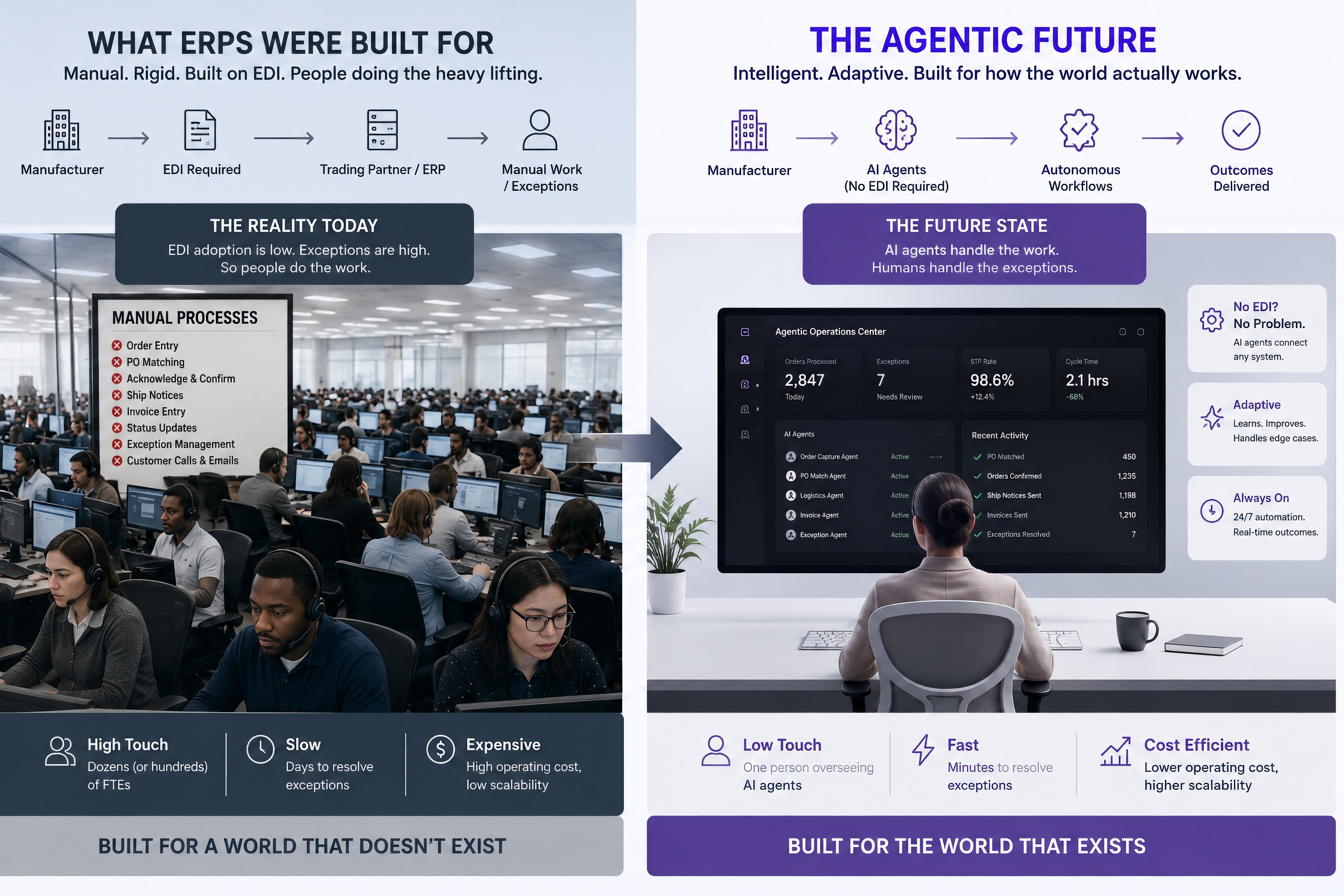
Peter Bendor-Samuel’s latest Forbes piece argues that AI is creating a vendor replacement wave across enterprise technology. Incumbents that don’t adapt their strategy will lose customers to AI-native challengers. His thesis is directionally right for most of enterprise software, where the competitive pressure is about pricing, product velocity, and whether incumbents can ship AI features fast enough to stay relevant.
But medtech order management is a different animal. The incumbents here — Movemedical, ImplantBase, WebOps — face something the broader SaaS market doesn’t: an architectural problem that no amount of AI bolting-on can fix, and a business model that actively punishes them for solving the customer’s actual problem.
The broader repricing is already underway
The macro pattern is worth understanding because it explains why medtech’s version of this is more severe.
Praveen Jonnala, CIO of Vistance Networks, wrote a CIO.com piece in May 2026 that frames the shift precisely: “Most enterprise platforms are not technological marvels. An ERP, stripped to its essence, is a workflow engine with a data layer.” His argument is that AI has changed the economics of writing software, and with it, the central premise of enterprise SaaS. “The moat was never the code,” he writes. “The moat was the cost of writing the code. That moat is draining” [1].
The data backs him up. Retool’s 2026 survey of 817 enterprise builders found that 35% of teams have already replaced at least one SaaS tool with a custom internal build [2]. Enterprise SaaS spend now averages $55.7 million annually, up 8% year-over-year, while application portfolios stayed flat at around 305 apps — the increase is coming from pricing inflation, not new tools [3]. Customers are paying more for the same software and noticing the gap between cost and value delivered.
Constellation Research puts it bluntly: the ERP category “is about to get a lot more interesting over the next 12 to 18 months amid new entrants, margin compression, new experiences and AI agents” [4].
That’s the macro picture. Medical device operations has two additional problems the broader SaaS market doesn’t.
Problem one: the EDI dependency
The incumbent platforms in medtech order management — Movemedical, ImplantBase, WebOps — share a common architectural assumption. They were built for a world where trading partners exchange data through EDI (Electronic Data Interchange), the structured protocol that’s been the backbone of supply chain communication since the 1980s.
EDI works when both sides have it. In pharmaceutical distribution, adoption is near-universal — that’s a mature, consolidated market where the major distributors (McKesson, AmerisourceBergen, Cardinal Health) mandated EDI decades ago. But medical device distribution operates under completely different structural conditions. The market is fragmented across thousands of small-to-mid-size manufacturers and distributors, most of them running 10 to 200 employees. These companies sell through networks of 1099 independent reps into hospitals and ambulatory surgery centers. Their ERP might be QuickBooks. Their “order management system” is a shared Gmail inbox.
These companies don’t have EDI infrastructure and, realistically, never will. The implementation cost and ongoing maintenance for a company running $20M in revenue with a three-person ops team doesn’t pencil. And because EDI requires both the sender and receiver to support the protocol, even distributors who wanted EDI can’t use it when their hospital customers and independent reps aren’t sending structured data.
What these companies actually receive is a charge sheet photographed on a phone at 7:45 AM after a total knee replacement. A PDF purchase order emailed from a hospital’s materials management department. A text message from a field rep saying they need three of SKU-4472 at St. Mary’s by Tuesday. That’s how the majority of this market actually communicates, and none of it has anything to do with EDI.
The incumbent platforms can’t process these inputs natively. They were designed to receive structured data from structured systems. When the input is a JPEG of handwriting, or a PDF with no standard template, or a text message with abbreviations and typos, the platform needs a person to read it, interpret it, and type it in — which is exactly the problem it was supposed to solve.
This is the architectural vulnerability Bendor-Samuel’s thesis points to, but it’s worse than the generic version. In the broader SaaS market, incumbents can potentially bolt AI features onto their existing architecture and stay competitive. In medtech order management, you can’t bolt AI document processing onto an EDI-first architecture and call it solved. The architecture assumed structured inputs. Unstructured inputs require a different approach to data ingestion entirely.
Problem two: the seat-based trap
The second problem is subtler, and it’s the one that should worry incumbents more.
Movemedical, ImplantBase, and WebOps price on seats. Their revenue scales with the number of people logging into the platform. This is standard SaaS economics, and it worked fine when the implicit promise was “we’ll help your team work more efficiently within the system.” More users, more value, more revenue.
But the customer’s actual problem isn’t “my team needs a better tool to work in.” The problem is that too many people are touching orders at all. A VP of Operations at a mid-size orthopedic manufacturer told us: “We’d rather spend that on a sales headcount than somebody in the back office. That’s the value proposition.” Another, at a growing spinal implant company: “As we grow, we just bring on more. We just burn cash.”
These buyers don’t want to arm their ops team with a better interface for typing data into an ERP. They want fewer people typing data into the ERP, period.
Seat-based pricing works against that goal. If the platform automates order intake so thoroughly that a six-person CS team can shrink to two, the vendor just lost four seats of recurring revenue. Full automation doesn’t expand the contract — it shrinks it.
This is a sharper version of Jonnala’s SaaS repricing argument. The issue goes beyond AI making code cheaper to build. The incumbent business model is structurally opposed to delivering the outcome customers actually want. Fewer people touching orders means faster processing and lower cost per transaction for the customer, but it means less revenue for the vendor. The incentives point in opposite directions.
Compare this to consumption-based pricing, where you pay for orders processed, not seats filled. Under that model, more automation means more value delivered at lower cost per transaction. The vendor’s incentive is to automate as aggressively as possible because throughput drives revenue. The customer’s incentive is to send more volume through the system because the cost per unit drops as efficiency increases. The incentives are aligned.
Any ops leader evaluating their current vendor’s roadmap should ask a pointed question: if the platform charges per seat, why would their product team build features that reduce the number of seats you need? (We wrote in more detail about why per-rep pricing breaks down in medical devices and how we price instead.)
The ERP gap is the real battleground
Both the Forbes vendor-replacement thesis and the CIO.com SaaS-repricing thesis miss a third layer because they’re written from outside the medtech operating environment.
ERPs — Business Central, NetSuite, QuickBooks, Fishbowl, Macola, SAP — are financial systems. They’re designed to store clean, validated transaction data and generate invoices, recognize revenue, track inventory at a ledger level. They do this well. What they don’t do, and were never designed to do, is create clean data from messy inputs.
A Fortune 500 orthopedic Senior Director confirmed this on a recent call: “An ERP is a financial system.” It can tell you a PO is unmatched. It can’t read the PDF, find the case, check the contract price, and chase the rep for the missing lot number.
The gap between “rep sends order from the field” and “clean transaction lands in the ERP” is where the actual operational cost lives. This is the investigation loop — the back-and-forth, the six cycles of chasing a missing field, the coordinator who knows that when Dr. Kim’s office sends “the usual” for a revision knee they mean a specific set of catalog numbers that are nowhere in the email.
This gap is what the incumbent platforms should be closing. Instead, they’ve built tools that assume the gap has already been closed — that someone has already read the email, interpreted the charge sheet, matched the PO, validated the pricing, and typed the clean data into a format the platform can accept.
McKinsey’s 2025 medtech report found industry operating margins sitting below 2019 levels, with fewer than 25% of medtech companies expected to improve both growth and margin through 2026 [5]. Roland Berger’s analysis of medtech financial performance shows the gap more specifically: the companies winning on profitability run SG&A at 28.6% of revenue, while underperformers sit at 34.4% [6]. That 5.8-point spread in SG&A is largely back-office operations cost — the people reading emails, matching documents, and typing data into ERPs.
The companies that close the gap between unstructured field communication and clean ERP data lower their cost basis structurally, in a way that compounds as they scale.
What the right architecture looks like
The approach that matches how medtech commercial operations actually work doesn’t start with EDI. It starts with the reality that orders arrive as PDFs, photos, and emails, and works backward from there.
AI document processing can read a photographed charge sheet with handwriting that, in the words of one VP Ops, looks like “somebody took a shotgun to it with ink.” The same system extracts catalog numbers, lot numbers, and quantities from a non-standard PDF purchase order, or parses a text message from a rep and maps “3x 4472 for St. Mary’s Tues” to a specific SKU, facility account, and delivery window.
The system reads whatever arrives — email, fax, portal submission — and structures it without requiring EDI from either side of the transaction. The hospital doesn’t install anything, the rep doesn’t adopt a new protocol, and the only behavior change is sending an email instead of a text.
Deviceflow is processing millions in monthly order volume through this approach. The transaction data consistently shows the same distribution described in our analysis of what’s actually safe to automate: 60-70% of orders follow predictable patterns that require zero judgment, 20-25% need lightweight human review, and 5-10% are genuinely complex cases where experienced ops people earn their salary.
The incumbent platforms would need to rebuild their data ingestion layer from the ground up to handle unstructured inputs natively. And if they did, they’d face the seat-based revenue problem: a system that truly automates order intake reduces the number of people who need to log in.
What this means for the buyer
The vendor replacement wave Bendor-Samuel describes is already happening in medtech order management, but the trigger isn’t AI features or pricing pressure. It’s the structural mismatch between what incumbents were built to process (EDI), how the market actually communicates (email, photos, PDFs), and how incumbents get paid (seats).
If you’re evaluating your operations stack, three questions cut through the marketing:
First, what percentage of your trading partners actually support EDI today? If the answer is less than half — and for most small-to-mid distributors it’s far less — any platform that depends on EDI is leaving the majority of your order volume in manual processing.
Second, does your platform’s pricing model reward automation or punish it? If you pay per seat, your vendor has a financial incentive to keep humans in the loop. That’s not a conspiracy — it’s arithmetic.
Third, where does your platform sit relative to the ERP gap? Does it process the messy inputs your field team actually sends, or does it assume someone has already cleaned them up?
The medtech incumbents may not face the immediate repricing pressure that Jonnala forecasts for the broader SaaS market. But they face something worse: a market that’s outgrowing their architecture while their business model prevents them from catching up.
Sources:
[1] Praveen Jonnala, “The SaaS Reckoning: Why AI Is About to Reprice Enterprise Software,” CIO.com, May 20, 2026.
[2] Retool, “2026 Build vs. Buy Shift Report,” cited in VentureBeat, 2026. Survey of 817 enterprise builders.
[3] Zylo, “2026 SaaS Management Index,” 2026.
[4] Constellation Research, “Disruption Coming for ERP and Not from Where You’d Think,” 2026.
[5] McKinsey & Company, The Transformation Imperative in Medtech, 2025.
[6] Roland Berger, Future of MedTech: From Growth to Profit, 2024, p. 2.