
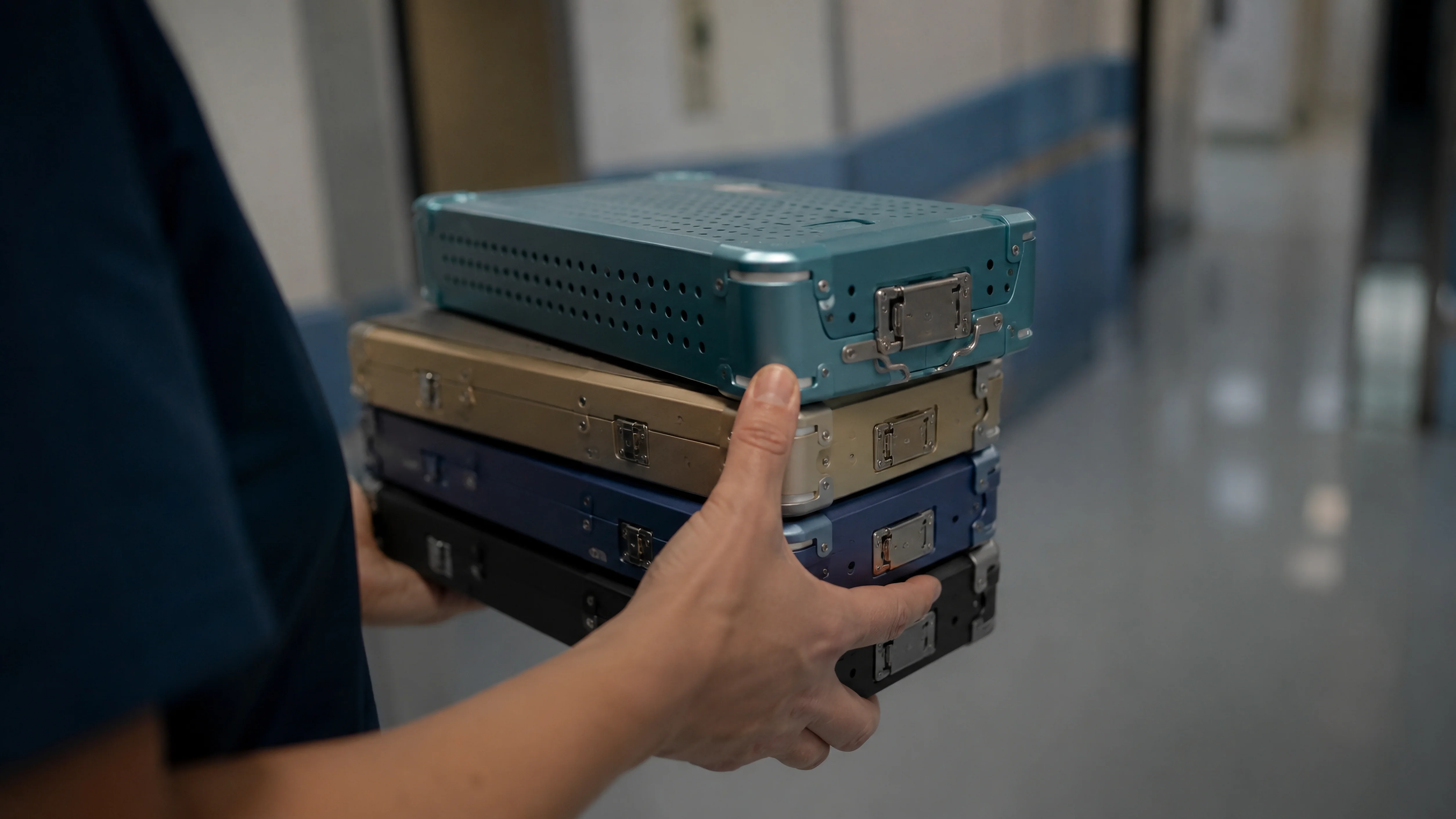
Most manufacturers think they win rep or distributor loyalty with a better product and a richer commission. In medtech, neither one is yours to control for long. Product differentiation narrows every year as segments mature, and commission is table stakes, and the moment you lead with it your competitor matches it. What you can control is whether the rep finishes a case with your line and gets paid in two weeks, or finishes a case with your line and spends the next month chasing a PO, reconciling a pricing mismatch, and explaining to the surgeon’s office why the invoice is wrong.
That difference is loyalty. And almost nobody is competing on it.
Here is the structural fact most manufacturers underweight: you do not employ the people who sell your product. Your go-to-market in hip, knee, spine, and trauma is a network of independent distributorships and 1099 reps, and most of those reps carry more than one line. The buying side has shifted too. BMMG’s February 2026 survey of 173 commercial executives from early- and growth-stage medtech companies found that “clinical superiority alone is rarely sufficient to drive adoption” — hospitals now evaluate technologies through a financial and operational lens alongside the clinical one, and the highest-performing companies are “not simply launching products — they are engineering adoption” through commercialization infrastructure.[1]
So the question that decides your quarter isn’t whether your product is good. It’s whose case the rep submits first on Friday afternoon, when they’re carrying four manufacturers’ implants and only have the energy to clean up the paperwork on one or two.
Loyalty in distribution is two relationships, not one
There are two distinct loyalties to win here, and they run on different mechanics.
The first is the distributor business: the principal who signs the agreement, manages the territory, and decides which lines the firm invests in. Their loyalty is operational and slow to move. It’s built on switching costs, on whether your line is profitable to administer, on whether they have visibility into their own inventory and cash. When a distributor principal goes quiet on a line, it’s rarely because the product got worse. It’s because carrying it became expensive in ways that never show up on a rate card.
The second is the individual rep: the 1099 who’s in the OR, who knows the surgeon, and who decides week to week where their effort goes. Their loyalty is personal and it moves fast. It’s built on whether your line makes their day easier or harder, whether they get paid quickly, and whether your back office treats them like a partner or like the unpaid AR department.
You have to win both. And both are decided in the same place: the gap between what the rep sends from the field and what your systems can actually act on.
Shift 1: Compete on the transaction, not the product
When everyone’s implant clears the same clinical bar, the rep’s choice gets made on something else. Increasingly that something else is friction. The BMMG 2026 findings translate directly to the rep relationship: if hospitals are no longer adopting on clinical superiority alone, reps aren’t pushing on it alone either. The line that’s easiest to transact is the line that gets pushed. Ease of doing business is now a feature of the product, whether you’ve decided to build it or not.
This isn’t a marketing problem. The reps who carry your line don’t experience your brand. They experience your back office. They experience the wait between submitting a case and getting paid, the number of pricing disputes per quarter, the time it takes to resolve a missing lot number, the calls from supply chain asking where a PO that’s been sitting in your inbox for two weeks went. The competitor who runs that loop faster is the one who carries the rep’s mindshare on Monday morning.
Shift 2: Get the rep paid faster than your competitor does
A rep’s loyalty follows their commission check, and their commission check follows the invoice. This is the most direct lever you have, and it’s almost entirely an operations problem rather than a finance one.
Here’s the mechanism most manufacturers miss. When billing is slow, reps hold POs to manage their own quota timing. They sandbag cases because there’s no reason not to. Speed-to-invoice doesn’t just help your finance team’s DSO; it changes what the rep does with your line. When a case closes Tuesday and invoices the same week, the rep has no incentive to sit on it. When a case takes weeks to turn into cash — “which is brutal,” as one surgical services leader put it on a call earlier this year — you’ve taught the rep that your line is the one they deal with later.
This is winnable, and the numbers we see in our own customer base prove it. Deviceflow customers have cut billing error rates by 60% and pulled 15-plus days out of their collection cycle, not by hiring a bigger billing team but by closing the gap between the rep’s charge sheet and the invoice before a human ever touches it.[2] The manufacturer whose reps get paid two weeks sooner doesn’t have to explain why their line is worth pushing. The check explains it.
Shift 3: Take the back office burden off the rep, don’t add to it
Salesforce’s 2026 State of Sales report (cross-industry, not medtech-specific) found that reps spend more than half of their time on nonselling work — 60% non-selling on average, with 11% of the workweek going to manually entering data.[3] In medical device, that work doesn’t sit cleanly between meetings. It happens after each case, late at night, between hospitals, on top of the four manufacturer lines your top rep already carries in their head. Every hour of that work your line demands is an hour the rep resents, and resentment is the slow leak that drains a line’s mindshare.
I’ve yet to find a better description of why these systems fail than the one a 20-year ortho rep — someone who’d carried J&J, Stryker, and SI-BONE lines — gave in a 2024 Tegus expert interview. Asked how his current company’s inventory tool works, he put his finger on the problem: “The Achilles heel of it is you’re purely reliant on the rep to do that, to input that.”[4] When the whole system depends on a busy rep manually entering data between cases, the data doesn’t show up, and the rep who has to chase it learns to dread your line.
The fix isn’t a better app for the rep to log into. Some reps don’t log in. The fix is meeting them where they already work: they email a photo of the charge sheet, and the work of reading it, checking the price against the contract, and pushing it into the ERP happens without landing back on their plate. The rep does a little — sends an email instead of a text — and the back office gets structured data instead of a puzzle. The line that asks the least of the rep while still getting the data right is the line they’ll carry without thinking about it.
Shift 4: Give the distributor a window, not a black box
This is where you win the company-level relationship. Distributor principals are running a business on top of your consignment inventory, and most of them are flying blind. “A lot of our stuff goes on consignment. It goes out for our distributors — who knows what they do with it sometimes. It’s kind of a black box,” is how one spinal implant manufacturer described their own field inventory to us this year. A senior director at a Fortune 500 ortho division put it more bluntly when describing their field tray operations: “There’s 27 toy boxes, and the toy boxes move.” The same blindness runs the other direction: the distributor often can’t see what’s been billed, what’s outstanding, or where their trays are.
The 20-year rep in the Tegus interview wanted the same thing the principal wants: a window. He described wishing he could see what other reps in his region were holding “so I don’t have to spend an hour calling or texting people and waiting for a response.”[4] That hour, multiplied across a territory, is the operational tax of running your line. Take it off the table and you’ve made your line cheaper to carry than the alternative. Visibility is what turns a transactional distributor relationship into an operational dependency, and operational dependency, not a contract, is what keeps a distributor invested through a slow quarter.
Shift 5: Make the system sticky by making it useful
Switching costs in distribution are real, but they don’t come from contract lock-in. They come from a line being woven into how the distributor actually runs. The same rep who shrugged at an early inventory tool — “from a rep standpoint, it has no real impact on my business whatsoever” — described his current digital system completely differently: “I do see a big impact just from feeling organized.”[4] When the interviewer asked how hard it would be for the organization to rip the system out once it’s in, his answer was blunt: “It would be pretty difficult to take that out.”[4]
That is what stickiness actually is. A system becomes hard to leave not because you trapped anyone, but because going back to the old way visibly hurts. It’s the same reason the best operational platforms in any industry are hard to leave: not penalties for switching, but the absence of any reason to want to. Loyalty is mostly the absence of a reason to leave. Build the operational layer that makes your line the easy one, and the rep doesn’t choose you each week so much as never finds a reason to choose against you.
The 2026 manufacturer mindset
The manufacturers worth watching have stopped treating reps as a channel they push product through and started treating them as customers whose loyalty gets re-earned every case. That reframe changes where the money goes. It’s the argument for spending on operations instead of another rebate, because a rebate buys this quarter’s volume while a faster, cleaner transaction buys the rep’s default behavior for years.
It’s also the argument against assuming your ERP has this covered. As one Fortune 500 ortho senior director put it on a recent call: “An ERP is a financial system.” It can tell you a PO is unmatched. It can’t read the PDF, find the case, check the contract price, and chase the missing lot number. That work is exactly what stands between your rep and their commission, and it’s exactly the work BMMG describes when they talk about engineering adoption — the operational infrastructure underneath a commercial motion, not the motion itself.
None of this requires a better implant. The hard part, the part your competitors are mostly ignoring, is the unglamorous operational layer between what the field sends and what your systems need. The manufacturer that’s easiest to do business with wins the most mindshare. In 2026, the line a rep pushes won’t be the one with the cleverest device. It’ll be the one that pays them on time and stays out of their way.
When a rep walks into the OR Monday carrying four lines, which one have you made the easy one to submit?
References
- BMMG (Bichsel Medical Marketing Group), MedTech Commercialization Flagship Report, February 2026, pp. 4, 7, 10, 13, 33–34. Survey of 173 commercial executives at early- and growth-stage medtech companies.
- Deviceflow customer outcomes — Medical Ventures case study and internal customer metrics (2025–2026).
- Salesforce, State of Sales, 7th Edition (2026), p. 8. Cross-industry survey of ~4,000 sales professionals; the 60% nonselling and 11% manual data entry figures are reported in aggregate, not broken out by industry vertical.
- Tegus expert interview, Territory Account Manager, 2024. Quotes verified at pp. 5–7 of the transcript.