
Double your case volume without doubling your ops team.
Deviceflow automates the coordination work between surgery and invoice so your team handles exceptions — not data entry.
See where work is stuck — before it stalls cash
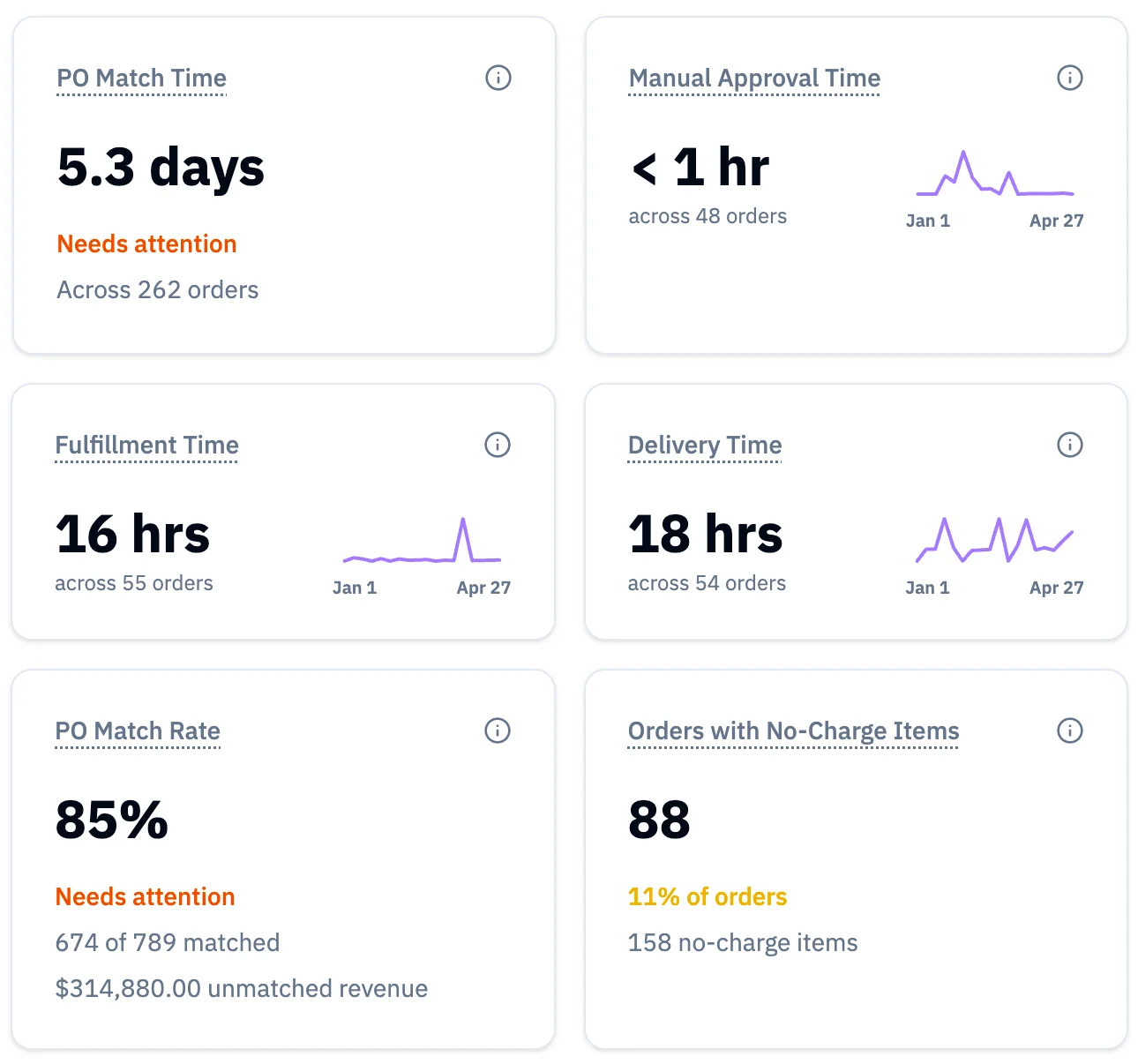
Your team knows there's a backlog. They just can't tell you which orders, which distributors, or which step is slow until they dig through inbox threads. Deviceflow surfaces every operational SLA in real time — PO match time, manual approvals, fulfillment, delivery, no-charge items — so the bottleneck shows up the moment it forms.
Before Deviceflow
Backlog you discover when something breaks. Bottlenecks invisible until they show up in the AR aging report or a distributor escalation.
After Deviceflow
Live operational SLAs by stage, distributor, and step. Triage tomorrow's exceptions today — and walk into ops reviews with the data already pulled.
The Problem
Your ops team is the connective tissue of the entire commercial operation — the intelligence between what the field sends and what your systems need. They live in a shared inbox, researching transactions for hours every day: reading POs from PDFs, matching to cases, chasing mismatches across email threads. Each touch costs $25-$50 in labor. Multiply that across hundreds of cases a month and you're looking at six figures in processing cost alone. But the machine doesn't scale — every new distributor and every new territory means more manual work for the same small team.
Your Team Lives in a Shared Inbox
Your ops specialists spend 3–6 hours per day researching transactions from a shared email inbox. POs arrive as PDFs, bill-onlys come as photos, and every mismatch requires digging through threads to figure out what happened. Each touch costs $25-$50 in labor. A single bill-only passing through 3–4 hands costs $100–$200 before it becomes cash.
What teams tell us“Everything starts in the inbox. Someone has to go through each email, extract the information, and manually enter it into our system.”
Deviceflow reads every inbound email and attachment, classifies it, and routes it to the right workflow — so the inbox stops being where work goes to get researched by hand.
Can’t Scale Without Hiring
Volume doubles = headcount doubles. Six CS reps at $60–80K each is nearly half a million a year in processing labor — money that could fund four quota-carrying reps instead. Hard to justify new billers at a growth-stage company, but your current team is at capacity and the next growth milestone will break them.
What teams tell us“We'd rather spend that on a sales headcount than somebody in the back office. That's the value proposition.”
Deviceflow automates the reading, matching, and entry and surfaces only the exceptions — so you take the next growth milestone without adding back-office headcount.
Fragmented Systems, Zero Source of Truth
Accounts live in CRM, orders in ERP, POs stuck in inboxes, inventory in spreadsheets. When someone asks “where is this order stuck?” the answer requires checking 4 different systems and asking 3 different people.
What teams tell us“All of our customer data and purchase orders are in Salesforce, all of our inventory and invoicing occurs in QAD. I manage all of our projects through Smartsheet. How do we get it all to interact?”
Deviceflow sits on top of your CRM, ERP, and spreadsheets, reconciles what’s scattered across them, and answers “where is this order stuck?” in one view.
Single Points of Failure Everywhere
What happens when your best biller calls in sick? When the ops person who “just knows” how distributor X sends POs is on vacation? Tribal knowledge runs your operation — and tribal knowledge doesn’t scale.
What teams tell us“These people are earmarked to come into the hospital operations space, but we can't bring them in because they're stuck in this legacy process.”
Deviceflow encodes how each distributor sends POs into the workflow itself, so the process runs the same whether your best biller is in or out.
Field Inventory You Can’t Trust
Your reps self-report their own inventory counts — the same reps who are running between cases all day. That’s a conflict of interest built into the process. And even when counts are accurate, you only know where inventory is, not where it should be. Those are two different problems that require two different systems.
What teams tell us“A lot of our stuff goes on consignment. It goes out for our distributors — who knows what they do with it sometimes. It's kind of a black box.”
Deviceflow captures inventory from shipments, deliveries, and case usage instead of rep self-counts, and tracks both where stock is and where it should be.
You’re Scrapping Good Inventory — and Paying to Rebuild It
Reverse logistics is the part nobody has solved. Good product gets returned and scrapped while product you actually need sits unaccounted for, so you remake what you already had.
What teams tell us“We paid them to throw away our good stuff and then wondered why we didn’t have it. So then we paid money to make more. It was an absolute waste of time.”
Deviceflow tracks returns and replenishment by lot and location, so what comes back gets put back to work instead of thrown away.
You Know the SKUs. You Don’t Know the Sets.
You can see individual part numbers, but not what’s actually in each tray or kit, or which sets a rep is carrying — so reps Frankenstein their own kits and par levels are a guess.
What teams tell us“We don’t actually know what’s in the set. We don’t actually know what sets they have. We only know what SKUs they have.”
Deviceflow tracks inventory at the set and kit level, not just the SKU, and enforces the min/max you set so reorders match real usage.
How Deviceflow Solves It
| Capability | What It Means for You |
|---|---|
| Email & Attachment Classifier | Automatically reads inbound emails and attachments, classifies them as direct orders, bill-onlys, or chart sheets, and routes to the right workflow. Your inbox stops being the system of record. |
| Auto-Matching Engine | Links POs to bill-onlys using date, MRN, surgeon, facility, and more. Surfaces mismatches as explicit tasks — instead of hidden errors your team discovers days later. |
| Unified Work Queue | One prioritized inbox of “action required” tasks with clear next steps. Approvals routed to defined approvers. Nothing falls through the cracks, even when team members are out. |
| Inventory Orchestration | Two layers of inventory intelligence: where inventory is (real-time tracking from shipment to trunk to consignment) and where it should be (demand-based allocation and rebalancing). Routes stocking orders automatically and syncs movements across all distributors. |
| Real-Time Dashboards | Open bill-onlys, unmatched POs, inventory warnings, and approval queues — all in one view. Answer “where is this order stuck?” in seconds instead of checking 4 systems and asking 3 people. |
Email & Attachment Classifier
Automatically reads inbound emails and attachments, classifies them as direct orders, bill-onlys, or chart sheets, and routes to the right workflow. Your inbox stops being the system of record.
Auto-Matching Engine
Links POs to bill-onlys using date, MRN, surgeon, facility, and more. Surfaces mismatches as explicit tasks — instead of hidden errors your team discovers days later.
Unified Work Queue
One prioritized inbox of “action required” tasks with clear next steps. Approvals routed to defined approvers. Nothing falls through the cracks, even when team members are out.
Inventory Orchestration
Two layers of inventory intelligence: where inventory is (real-time tracking from shipment to trunk to consignment) and where it should be (demand-based allocation and rebalancing). Routes stocking orders automatically and syncs movements across all distributors.
Real-Time Dashboards
Open bill-onlys, unmatched POs, inventory warnings, and approval queues — all in one view. Answer “where is this order stuck?” in seconds instead of checking 4 systems and asking 3 people.
Go deeper on what matters to you
Field Operations
Case coordination from intake to post-op — without the group texts and phone calls.
Inventory Management
Consignment, trunk stock, and transfers tracked across every location in real time.
Billing Automation
PO matching, reconciliation, and invoice generation — same day, not same month.
Distributor Portal
One view across all your distributors. Standardized data without forcing process change.
What Ops Leaders Ask Us
We'll show you what that looks like automated. Book a 30-minute walkthrough.