
Restocked before anyone asks.
Most teams replenish reactively — a case closes, a box ships overnight. Deviceflow forecasts demand per account, applies your par rules, and consolidates replenishments into fewer, planned shipments. Product is on the shelf before the next case, and your freight bill stops growing with your case volume.
- Par rules per account and location
- Replenishment driven by forecasted demand
- Consolidated shipments, less overnight freight
- Stockout risk flagged before case prep
“A lot of our stuff goes on consignment. It goes out for our distributors — who knows what they do with it sometimes. It's kind of a black box.”
How replenishment flows through Deviceflow
From the rep's charge sheet photo to the consolidated shipment leaving your warehouse — every step runs on real usage, live par levels, and forecasted demand.
A case consumes inventory
The rep photographs the charge sheet or scans usage after surgery — the same capture that drives billing. Deviceflow records what was used, down to product, size, and lot, and updates on-hand inventory at that account in real time.
Par rules do the math
Every account has its own par levels — set by you, per product, per location. Deviceflow compares what is actually on the shelf against par, so replenishment reflects what the account is short, not just what the last case used.
The forecast looks ahead
Scheduled cases and each account's consumption history feed a demand forecast. An account with three knees on next week's calendar gets treated differently than one with nothing scheduled — same product, different urgency.
Shipments consolidate
Instead of a box out the door after every case, Deviceflow groups replenishments by account and timing — one planned shipment that arrives before the inventory is needed, not five overnight packages that arrive after.
Product is there for the next case
Inventory stays above par at every account. Your warehouse ships less often, reps stop calling about missing sizes, and nobody discovers a stockout during case prep.
Two replenishment strategies. Same case volume.
We modeled the same account under two strategies. The orange line is reactive reordering — a shipment after every case, the way most companies operate today. The blue line is Deviceflow's par-level algorithm — demand forecasts and per-account par rules deciding what ships and when. In the simulation, inventory at the account stays above par the entire time, and total shipments fall by more than half.
Reactive reordering
A shipment after every case. Inventory swings hard, freight costs grow one-for-one with case volume, and stockouts still happen because nothing looks ahead.
Par-level replenishment
Forecasted demand and per-account par rules consolidate shipments. In the simulation: inventory never drops below par, and shipment count falls by more than half.
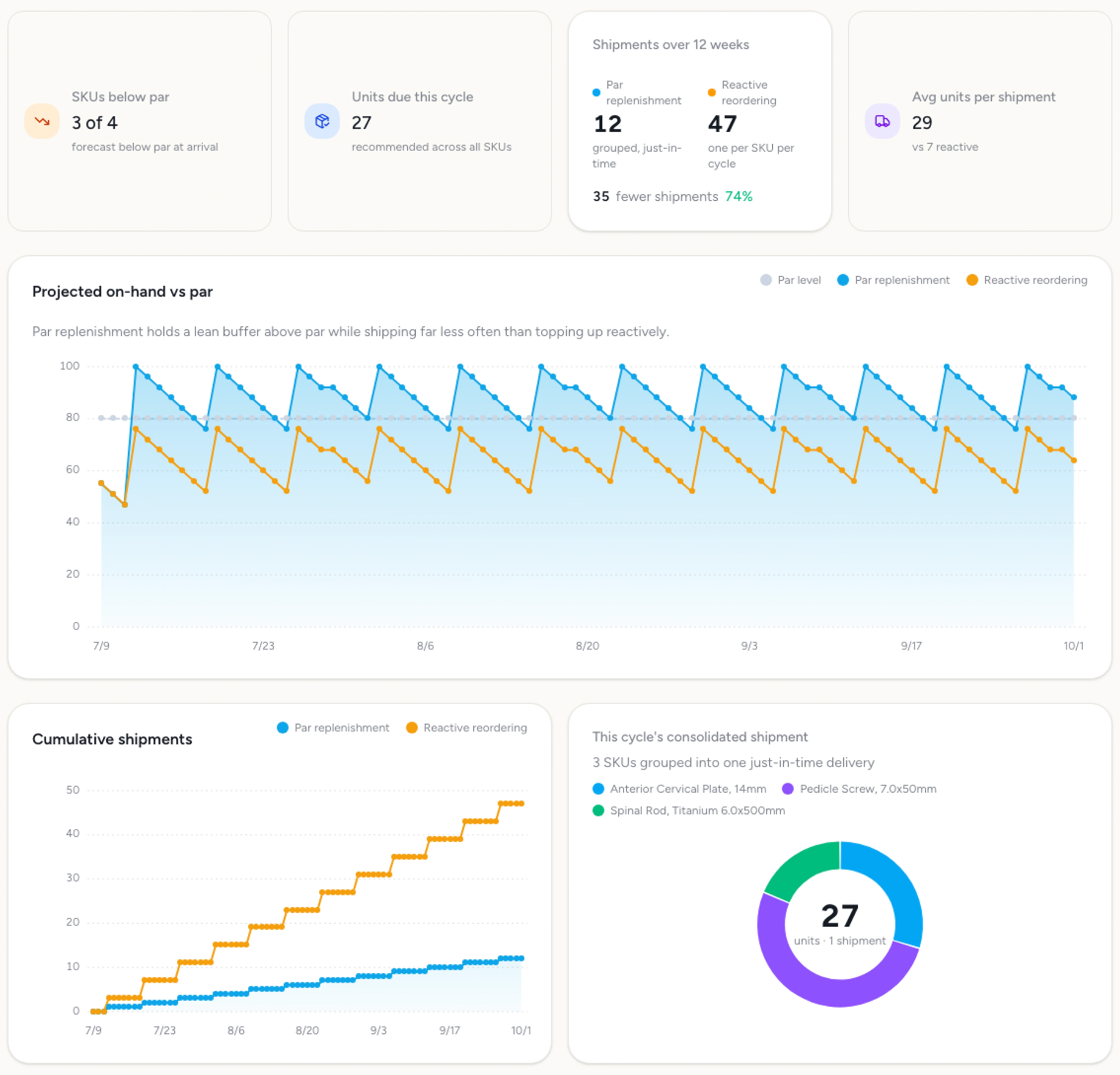
Reactive reordering vs. par-level replenishment
Shipping after every case feels responsive. It's actually the most expensive way to keep the field stocked — and it still doesn't prevent stockouts.
What's included
Replenishment is one output of the same system that tracks your field inventory, coordinates your cases, and drives your billing. Nothing here requires new data entry — it runs on the usage your reps already capture.
Par levels are not one-size-fits-all. Set them per product, per account, per location — a high-volume trauma center carries different pars than an ASC doing two cases a month.
Scheduled cases and consumption history drive the forecast. Replenishment quantities reflect what each account is about to use — not just what it used last.
Replenishments group by account and timing instead of firing one at a time. Fewer boxes, fewer labels, less overnight freight.
When forecasted demand threatens to push an account below par, Deviceflow flags it with enough lead time to ship ground — not another overnight scramble.
Replenishment starts from the rep's charge sheet photo — the same usage capture that drives billing and inventory. No separate data entry, no new app for reps.
Consignment closets, trunk stock, loaner programs — par rules and forecasts apply across every location type Deviceflow already tracks.
Human oversight by design
Deviceflow automates the repetitive coordination work your team shouldn't be doing manually. When a decision matters — recall execution, compliance submissions, billing exceptions — the system routes it to your team for approval. Every automated action has a complete audit trail. No irreversible decisions happen without a human in the loop.
Validated for QMSR audits
Deviceflow ships with a full GAMP5 Category 4 validation package — URS, IQ/OQ/PQ protocols, requirements traceability matrix, supplier qualification, Part 11 access provisions, and tamper-evident audit-trail exports. Walk into your next QMSR inspection with the supplier documentation already prepared. Your quality team stays focused on the device, not on validating your ops stack. Read the validation burden brief →
Keep going
Read deeper or find your role
Background on field inventory work — and how replenishment lands for each leader.
Inventory & operations reading
For your role
If the answer is roughly one per case, there's freight and product availability on the table. We'll walk you through how par-level replenishment would work on your accounts.
The Space Between
What happens between what your field team sends and what your systems need — and what your team can stop doing manually.