
Validated before the auditor asks.
The QMSR transition pulled operations software into audit scope — the systems handling charge sheets, consignment, and order-to-cash now carry the same access, trail, and validation expectations as your QMS. Deviceflow is maintained in a validated state for every customer: GAMP 5 Category 4, Part 11-grade access provisions, and a validation packet produced with every release. In 2026, a manufacturer customer put Deviceflow through formal QMS validation — URS through vendor audit.
- GAMP 5 Category 4 — configured, not custom
- IQ/OQ/PQ protocols and traceability matrix
- Part 11-grade access controls and audit trails
- A validation packet with every release
What a validation cycle looks like
This is the full path a manufacturer customer ran with us — requirements through vendor audit. Your quality team drives it; the documentation is already prepared on our side, which is why the work moves quickly.
Requirements, signed
A user requirements specification signed by your ops and quality leads defines what the system must do in your process — charge sheet capture, consignment, order-to-cash, whatever sits inside your audit scope.
Specs and risk assessment
Functional specifications against the modules you actually use, plus a risk assessment scoped to your process — not a generic template stretched to fit.
IQ/OQ/PQ execution
Installation, operational, and performance qualification protocols run against your configuration. Every test produces evidence: videos, screenshots, captured emails, and audit logs per test.
Traceability and vendor audit
A traceability matrix maps every test back to your requirements, and you audit us as the software supplier — design controls, verification, release management. We carry the vendor side of the obligation.
Feature-flagged activation
New capabilities ship when we ship, but activation for your team waits until your own validation work closes. Our release cadence stays fast; your audit posture stays intact.
The documentation ships with the release.
Every release runs the full test suite and produces a validation packet stamped with the release date and the version that produced it — test videos, screenshots, captured emails, and audit logs per test. This is what your quality team receives, before anyone asks for it.
Built in-house
Custom ops software is GAMP Category 5 — your team carries the full validation package: URS, specs, IQ/OQ/PQ coverage, traceability, change control. If you built the system, you're the vendor for your own system.
Configured Deviceflow
Category 4 — the vendor-side burden stays with us. The packet arrives with each release, ready for your supplier file, and activation waits on your validation cadence.
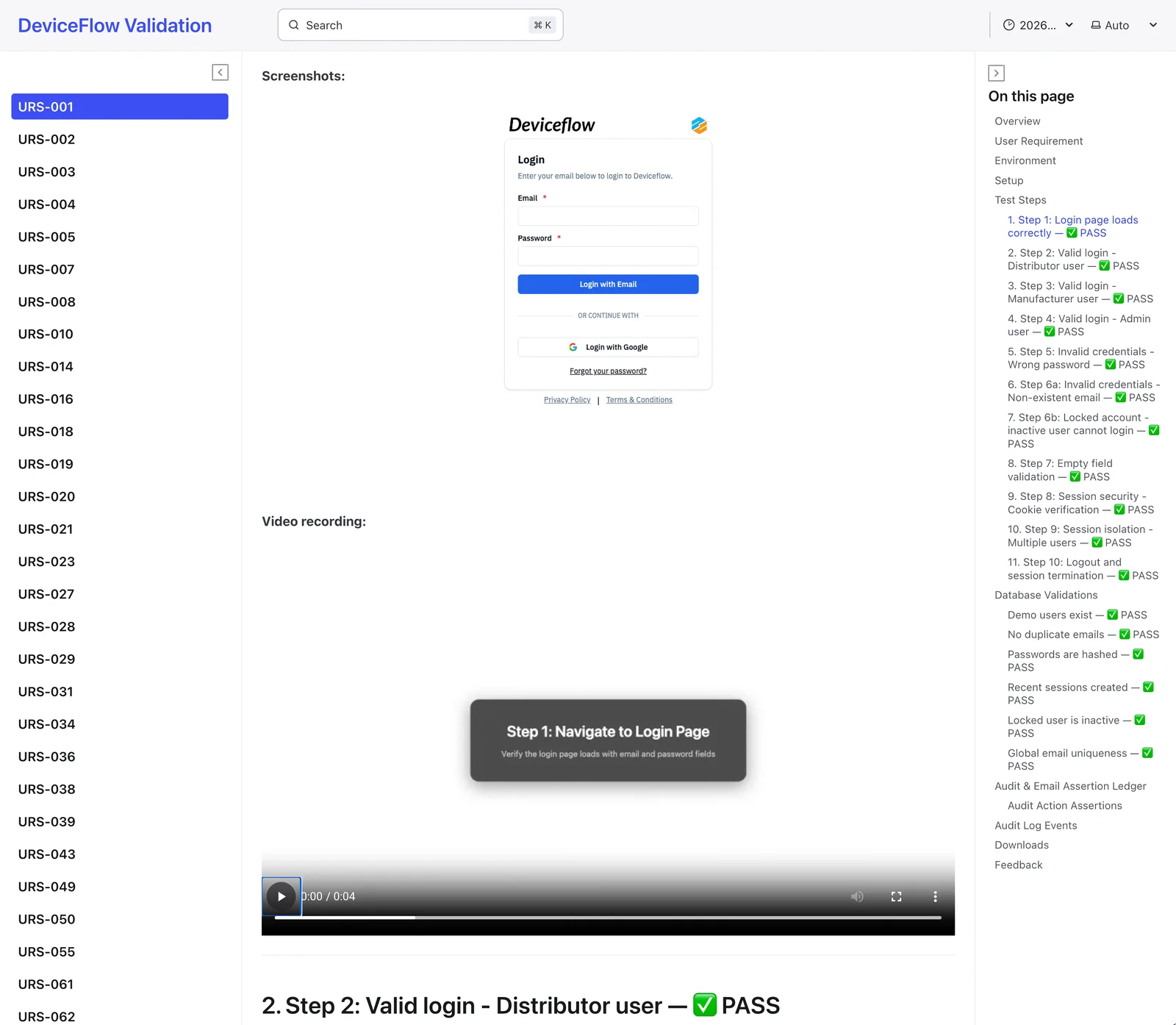
How the validated state is maintained
Validation isn’t a project we run once for an audit. It’s built into how every release leaves the building — and into the architecture decisions underneath the product.
Every release runs the full test suite — URS coverage, role-based access checks, data integrity, Part 11 audit trail verification — and produces a packet stamped with the release date and the version that produced it. The packet ships with the release, not after you ask.
Deviceflow is configured commercial software. Customers configure us — they never customize us into Category 5 territory. The vendor-side validation burden stays with us instead of landing on your quality team.
Role-based permissions, approval workflows, tamper-evident audit trails, and exportable logs — the access provisions inspectors now expect from any system inside QMSR scope.
Supplier qualification, vendor audit support, and the documentation trail your quality team needs for the supplier file — ready before the inspection, not assembled after the request.
Customer-data infrastructure runs on read replicas and multi-AZ failover with a documented backup policy. The data we hold for our customers stays available even if we don’t.
Security posture to match the regulatory one — HIPAA compliance and SOC 2-aligned controls across the platform, alongside the QMSR validation package.
Human oversight by design
Deviceflow automates the repetitive coordination work your team shouldn't be doing manually. When a decision matters — recall execution, compliance submissions, billing exceptions — the system routes it to your team for approval. Every automated action has a complete audit trail. No irreversible decisions happen without a human in the loop.
Validated for QMSR audits
Deviceflow ships with a full GAMP5 Category 4 validation package — URS, IQ/OQ/PQ protocols, requirements traceability matrix, supplier qualification, Part 11 access provisions, and tamper-evident audit-trail exports. Walk into your next QMSR inspection with the supplier documentation already prepared. Your quality team stays focused on the device, not on validating your ops stack. Read the validation burden brief →
Go deeper
The regulatory picture behind this page
Why operations software landed inside audit scope — and what it means for the build-vs-buy decision.
Background reading
- When your ops system became a validated systemThe three regulatory shifts that pulled ops software into validated-system scope.
- The validation burden of custom ops softwareGAMP Category 5 requirements and the build-vs-buy framework for manufacturer ops teams.
- Frequently asked questionsIntegrations, security, implementation, and pricing questions answered.
For your role
If the honest answer is “not sure,” that’s worth knowing before your next inspection — not during it. We’ll walk you through the validation packet and what a validation cycle looks like on your process.
The Space Between
What happens between what your field team sends and what your systems need — and what your team can stop doing manually.